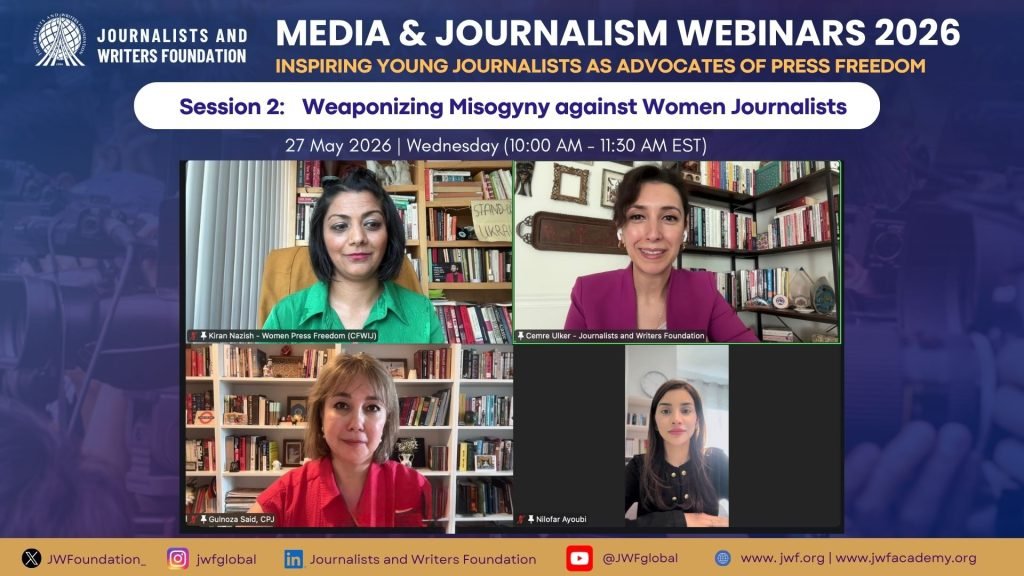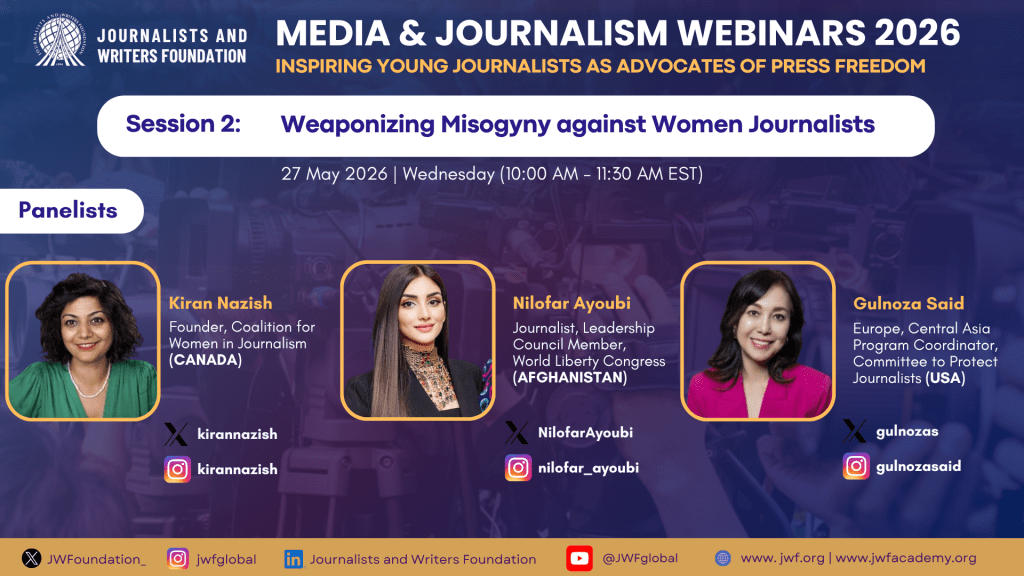
The Journalists and Writers Foundation hosted Session 2 of the 7th Annual Media and Journalism Webinars 2026 on 27 May 2026, under the theme “Weaponizing Misogyny against Women Journalists.” Held as part of the broader webinar series “Inspiring Young Journalists as Advocates of Press Freedom,” the session brought together young journalists, journalism students, media professionals, and human rights advocates from different countries for an urgent discussion on the gendered attacks faced by women journalists in both online and offline spaces.
The session examined how misogyny is increasingly used as a tool to silence, discredit, intimidate, and push women journalists out of public discourse. Speakers discussed online harassment, coordinated smear campaigns, digital violence, doxing, deepfakes, legal harassment, threats against families, psychological trauma, and the growing misuse of artificial intelligence in gender-based attacks against women in media.
 The session featured three distinguished speakers: Kiran Nazish, Founder of the Coalition for Women in Journalism; Nilofar Ayoubi, Afghan journalist, and Leadership Council Member at the World Liberty Congress; and Gulnoza Said, Europe and Central Asia Program Coordinator at the Committee to Protect Journalists.
The first speaker, Kiran Nazish, drew from two decades of experience as a journalist, foreign correspondent, and founder of the Coalition for Women in Journalism. She reflected on the growing scale of attacks against women journalists and emphasized that reported numbers often fail to capture the full scope of the problem. Nazish noted that many women journalists do not always report harassment or attacks because they may lack access to reporting mechanisms, feel unsafe, face time constraints, or fear professional and personal consequences. As a result, official figures often underestimate the real scale of gender-based violence targeting women in media.
She explained that through the Coalition for Women in Journalism and Women Press Freedom, her team has monitored a significant rise in online violence against women journalists since 2019. She highlighted a 280% increase in online violence within the landscape monitored by the organization, warning that technology is increasingly being used to intensify harassment, intimidation, and reputational attacks. Nazish described how online violence can include bullying, doxing, leaking of personal information, disinformation, and other forms of digital abuse that often produce real-life consequences. These attacks can expose women journalists to physical danger, professional isolation, emotional distress, and self-censorship.
Her remarks framed online misogyny not as isolated abuse, but as a structural press freedom issue. When women journalists are targeted through coordinated digital attacks, their ability to report freely is weakened, and the public loses access to important perspectives, investigations, and stories.
Artificial Intelligence, Deepfakes, and the New Frontline of Gendered Attacks
A major focus of Nazish’s remarks was the growing misuse of artificial intelligence. She warned that AI is increasingly being used to target women journalists through deepfakes, manipulated images, fake advertising content, and politically motivated smear campaigns. She explained that deepfake technology is no longer confined to political campaigns or high-profile figures. In some cases, fake images of women journalists have been used in commercial or public-facing content without their consent, showing how AI can be weaponized in diverse and harmful ways.
Nazish emphasized that this trend requires urgent policy attention. Advocacy alone is not enough. Governments, international institutions, and technology companies must work toward stronger accountability mechanisms, digital safety protections, and regulatory responses to prevent the misuse of emerging technologies against journalists.
A Lived Experience of Digital Violence and Gender Apartheid
 The second speaker, Nilofar Ayoubi, offered a deeply personal and powerful reflection on the lived experience of misogynistic attacks, digital violence, and authoritarian targeting. As an Afghan women’s rights defender and journalist, she connected the session theme to her own life, beginning from childhood under Taliban rule, when she was disguised as a boy in order to access education.
Ayoubi explained that gender-based control over women’s visibility, education, movement, and voice has long shaped her experience. She described how digital violence affected her even before the rise of AI, recalling early social media abuse, fake profiles created in her name, and public shaming in a conservative society where even a woman’s visible presence online could be treated as a violation of social norms. She reflected on how these early experiences affected her mental health and sense of belonging, while also highlighting the role of family support, especially her father’s encouragement, in helping her continue her education and public advocacy.
Speaking about Afghanistan today, Ayoubi emphasized the extreme pressure faced by women journalists under Taliban rule. She noted that women’s faces and voices have been increasingly erased from public media spaces, with female journalists forced underground or pushed out of the profession entirely. She warned that for women in Afghanistan and similar contexts, AI-generated abuse and manipulated images can have life-threatening consequences in contexts where honor, gender control, and authoritarian repression intersect.
Organized Smear Campaigns and Transnational Repression
Ayoubi also discussed coordinated campaigns targeting women journalists and human rights defenders. She described how attackers often drag families, children, friends, and personal relationships into campaigns of harassment in order to isolate women and damage their credibility. She emphasized that misogynistic attacks are often not random. They can be organized, politically motivated, and transnational. In her own case, Ayoubi described campaigns attempting to push false narratives against her, creating security concerns and even leading to questioning by authorities in countries where she had relocated.
Her remarks underscored that digital attacks do not remain “online.” They can affect immigration status, security assessments, family safety, employment opportunities, psychological well-being, and public credibility. This makes digital safety and reputational protection essential components of journalist safety. Ayoubi called for stronger solidarity networks among journalists, human rights defenders, and civil society organizations. She emphasized the need for an “anti-propaganda” network that can respond collectively to coordinated campaigns, support those under attack, and counter disinformation with verified information and solidarity.
Online Harassment in Authoritarian and Democratic Contexts
 The third speaker, Gulnoza Said of the Committee to Protect Journalists, broadened the discussion by drawing from her work across Europe, Central Asia, and other regions. She emphasized that online harassment against women journalists is not limited to authoritarian states. It occurs in democratic countries as well. Said noted that during CPJ missions to different countries, women journalists repeatedly reported online harassment regardless of whether they worked in authoritarian or democratic environments. This shows that gendered attacks against women journalists are a global press freedom concern, not a problem confined to one region or political system.
She highlighted the troubling role of major technology platforms. According to Said, journalists and press freedom organizations have often struggled to obtain meaningful responses from platforms when women journalists are targeted online. She discussed how the removal or weakening of content moderation systems on major platforms has intensified the problem, leaving journalists with fewer protections when targeted by coordinated harassment.
Said also addressed the rise of AI-generated sexualized abuse, including the use of tools that create fake intimate or nude images of women without consent. She emphasized that stronger regulation is needed not only for social media platforms, but also for AI companies and tools that enable image-based abuse.
Trauma, Self-Censorship, and the Cost of Online Violence
Gulnoza Said also emphasized that online attacks can lead women journalists to avoid sensitive topics, reduce their public visibility, or leave journalism altogether. While more women journalists are now reporting online harassment than in previous years, many still respond by practicing self-censorship after such incidents. This has consequences not only for individual journalists, but also for press freedom, democratic accountability, and the public’s right to information.
Said further highlighted that trans women journalists may face compounded risks, as they may be targeted both as women and as members of the trans community. Her remarks encouraged participants to approach journalist safety through an intersectional lens that recognizes how gender, identity, exile, race, sexuality, political context, and professional status shape vulnerability.
Institutional Support and Protection Mechanisms
The session emphasized the importance of institutional support for journalists facing online and offline attacks. Said encouraged journalists to contact organizations such as CPJ and other press freedom groups when they face threats, harassment, trauma, or displacement related to their work. She noted that CPJ has a global network of correspondents and representatives and provides different forms of support, including trauma support for journalists who have experienced severe threats or forced displacement.
This point was especially important for freelance journalists, who may not have the protection of a newsroom, editor, legal department, or institutional safety team. As the media industry increasingly shifts toward freelance and independent work, journalist protection mechanisms must adapt to support those working without traditional institutional backing.
Speakers emphasized that support for women journalists must include legal assistance, digital safety training, mental health support, emergency response mechanisms, advocacy networks, and stronger platform accountability.
Policy Change, Accountability, and the Role of Civil Society
Across the session, speakers agreed that misogynistic attacks against women journalists cannot be addressed through individual resilience alone. While personal courage matters, systemic harm requires systemic responses. Speakers called for stronger policy frameworks, greater accountability for technology companies, better regulation of AI-enabled abuse, improved reporting mechanisms, and stronger political will from governments and international organizations. They also emphasized that civil society organizations, journalist networks, human rights defenders, and international institutions must work together to close the gap between the speed of technological harm and the slower pace of legal and policy response. The discussion also highlighted the importance of solidarity. As digitally enabled authoritarianism and coordinated transnational harassment increasingly operate across borders, support networks for women journalists must also become more coordinated, faster, and better resourced.
Journalism as a Calling and the Need for Resilience
During the Q&A discussion, participants explored the emotional and professional consequences of harassment, including whether such violence pushes journalists to leave the profession. Said acknowledged that many journalists, especially those fleeing authoritarian environments or experiencing trauma, may leave journalism due to lack of financial security, mental health challenges, or safety concerns. However, she emphasized that organizations such as CPJ work to support journalists because their work remains vital to public accountability.
This exchange offered young journalists a realistic but encouraging message: journalism can be dangerous and emotionally difficult, but journalists are not alone. Support networks, institutional mechanisms, mentorship, and solidarity can help journalists continue their work with greater safety and resilience. The speakers demonstrated that misogyny is increasingly used as a political and digital weapon. It is deployed to silence women, discredit their reporting, isolate them from support networks, and discourage others from entering journalism. With the rise of AI, deepfakes, and coordinated disinformation campaigns, these threats are becoming more complex and harder to contain.
At the same time, the session highlighted pathways forward: stronger solidarity networks, digital security training, mental health support, legal and policy reform, platform accountability, AI regulation, and sustained advocacy at national and international levels. The session concluded with a renewed commitment to safeguarding women journalists and strengthening the next generation of press freedom advocates. As the Media and Journalism Webinars 2026 continue, JWF remains committed to empowering young journalists with the knowledge, networks, and ethical grounding needed to report with courage, defend public discourse, and uphold the principles of free and responsible journalism.