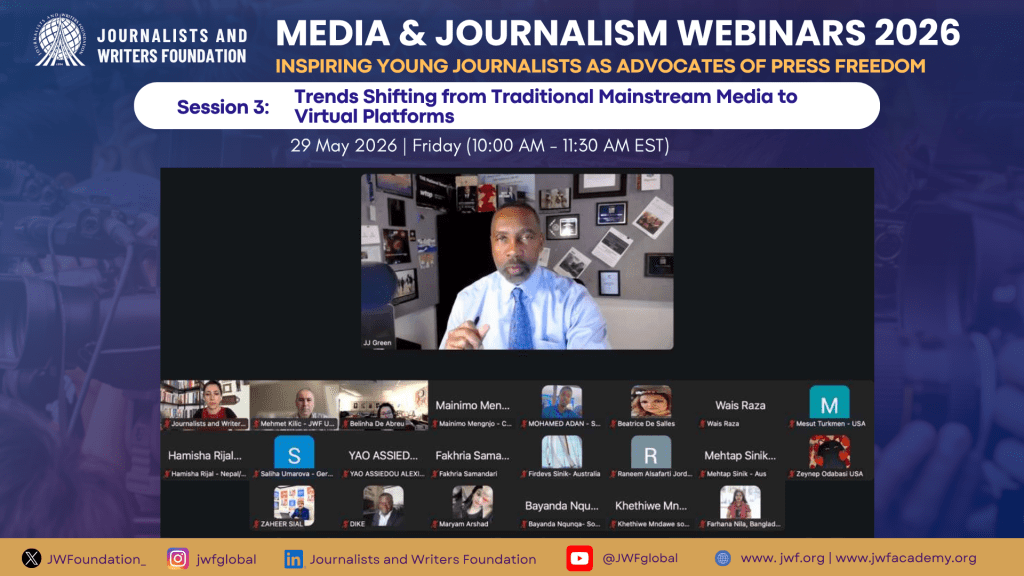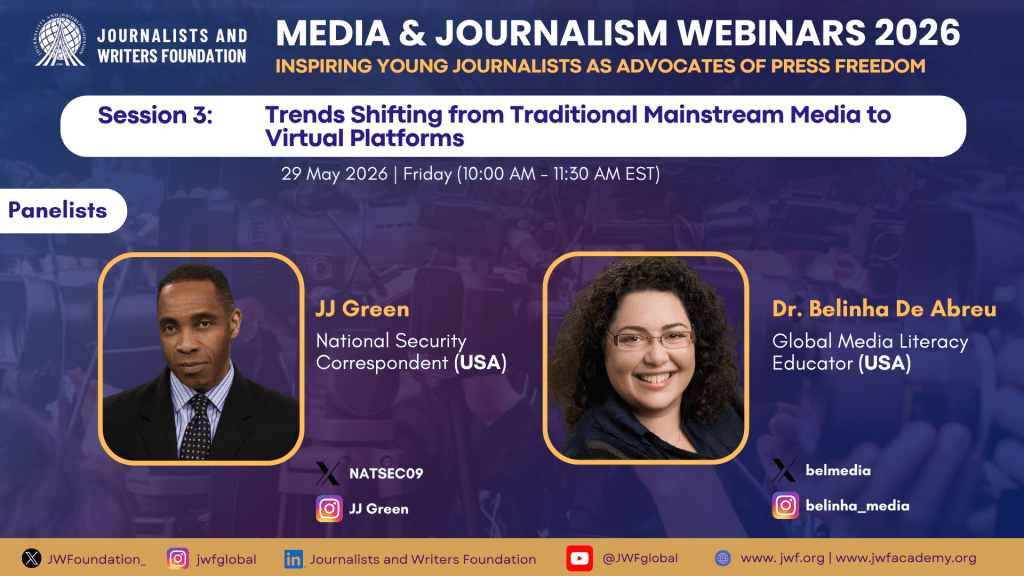
The Journalists and Writers Foundation hosted Session 3 of the 7th Annual Media and Journalism Webinars 2026 on May 29, 2026, under the theme “Trends Shifting from Traditional Mainstream Media to Virtual Platforms.” Held as part of the broader webinar series “Inspiring Young Journalists as Advocates of Press Freedom,” the session brought together young journalists, journalism students, media professionals, and emerging communicators from different countries to examine how the global information ecosystem is rapidly changing in the digital age.
The session explored the migration of public discourse from traditional media outlets, including newspapers, television, and radio, toward social media platforms, podcasts, YouTube, independent news websites, and creator-led digital spaces. Speakers reflected on both the opportunities and risks of this transformation, including broader audience reach, citizen journalism, freelance media work, disinformation, algorithmic amplification, declining public trust, and the human rights responsibilities of technology platforms. The session featured two distinguished speakers: JJ Green, National Security Correspondent at WTOP, and Dr. Belinha De Abreu, Global Media Literacy Educator, researcher, author, and President of the International Council for Media Literacy.
 The first speaker, JJ Green, opened his remarks by describing the migration of news and public discourse from traditional media institutions to virtual platforms as one of the most consequential transformations of our time. He emphasized that this shift is not only about technology, but also about trust, power, and democracy.
Drawing on more than two decades of reporting on national security, intelligence, terrorism, war, and global conflict, Green reflected on how information itself has become a battlefield. He explained that governments, adversaries, influence networks, and online actors increasingly manipulate narratives and use propaganda to shape public perception. What was once associated mainly with foreign influence operations, he warned, has now become part of everyday online life. Green emphasized that the information battlefield is no longer distant or abstract. It is present in people’s phones, homes, social media feeds, and everyday conversations. This shift affects how citizens view reality, evaluate institutions, understand political events, and engage with democratic processes.
A central concern in his remarks was the collapse of public trust. Green explained that when people no longer trust journalism, institutions, or even documented events, facts begin to lose value. Instead of asking whether something is true, people may begin asking which version of reality they prefer. This, he warned, creates a dangerous environment in which shared truth becomes fragile and democratic debate becomes increasingly difficult.
Green stressed that disinformation is not only a technological problem; it is also a human problem. It works because it exploits fear, anger, pride, identity, emotional attachment, and existing social divisions. Disinformation can feel convincing because it often tells people what they already want to hear or confirms what they already fear. He explained that disinformation does not always aim to persuade people of one specific falsehood. Often, its deeper goal is to create confusion, exhaustion, cynicism, and disengagement. When people feel that nothing can be trusted, they may withdraw from public debate altogether. This weakens democratic participation and creates vulnerability to manipulation.
 According to Green, the shift from traditional media to virtual platforms has accelerated this problem. Traditional journalism, while imperfect, generally operated with editors, verification procedures, legal review, and professional standards. Virtual platforms have democratized publishing, allowing excluded voices to reach wider audiences and enabling communities to tell their own stories. However, decentralization also means fewer filters between information and the public.
Green also addressed the difficult question of content moderation. He emphasized that free expression remains essential in any democratic society, including the right to criticize governments, challenge institutions, and express unpopular views. At the same time, he warned that completely unrestricted information environments can allow harmful falsehoods to spread unchecked. He described content moderation as a difficult balancing act. Too little moderation can allow disinformation, conspiracy theories, and harmful falsehoods to circulate widely. Too much moderation can suppress legitimate debate and raise concerns about censorship.
His remarks framed social media platforms not merely as technology companies, but as powerful information infrastructures. These platforms shape public conversations, influence elections, affect public health decisions, and impact national security. Yet many were built around business models that reward attention, engagement, and advertising revenue rather than truth, nuance, or democratic responsibility. One of the most important parts of Green’s presentation focused on the human rights responsibilities of digital platforms. He emphasized that social media platforms increasingly function as gatekeepers of information. In many parts of the world, social media is effectively the internet, determining what news is seen, what voices are amplified, and what perspectives remain visible or invisible.
Green reminded participants that human rights include freedom of expression, access to information, privacy, personal security, protection from discrimination, and participation in public life. Decisions made by technology companies can affect all of these rights. An algorithm change in one country can reshape political discourse in another. A moderation decision in one region can influence public debate elsewhere. A platform policy can affect journalists, activists, and citizens across borders. This reality, he argued, demands greater accountability, transparency, ethical leadership, and recognition that technology decisions increasingly carry human rights consequences.
Green concluded by emphasizing that the future should not be about abandoning technology or romanticizing a return to the past. Instead, societies need strong journalism, innovative digital platforms, independent creators, diverse voices, and citizens equipped with the skills to think critically in a noisy environment. He described media literacy as a critical civic survival skill, essential for verifying information, evaluating sources, identifying manipulation, and resisting emotional exploitation.
 The second speaker, Dr. Belinha De Abreu, built on Green’s remarks by focusing on the importance of media and information literacy in the current information ecosystem. As a global media literacy educator, researcher, and author, she emphasized that media literacy has become increasingly central to democratic participation, civic life, and responsible engagement with digital platforms.
Dr. De Abreu began by introducing a widely used framework for media literacy: the ability to access, analyze, evaluate, and create messages in a variety of forms, from print and video to the internet. She explained that media literacy supports inquiry, self-expression, and democratic citizenship. At the same time, she noted that media literacy must be communicated in ways that resonate with people’s lived experiences. For her, media literacy means thinking more deeply about media, processing it, verifying it, and understanding its role in our lives — both positive and negative.
Dr. De Abreu emphasized that although media is often discussed through a negative lens because of disinformation and manipulation, people also use and value media every day. Platforms such as TikTok, Instagram, YouTube, podcasts, and other virtual spaces are deeply embedded in everyday life. Therefore, the task is not to reject media, but to help people understand how to engage with it critically, ethically, and responsibly.
Dr. De Abreu highlighted that the current media environment requires more than technical skills. It requires reflection, judgment, responsibility, and awareness of how information is produced, circulated, monetized, and consumed. As audiences increasingly receive news from virtual platforms, users must be able to ask critical questions: Who created this content? What is the source? What evidence supports it? What might be missing? How is the platform shaping what I see? Why is this content being shown to me? Who benefits from my engagement?
 This kind of critical inquiry is especially important for young journalists and emerging media professionals, who must navigate a world where the boundaries between journalism, entertainment, influence, activism, advertising, and opinion are increasingly blurred. Dr. De Abreu’s remarks reinforced that media literacy is not only about identifying false information. It is also about understanding the broader systems that shape visibility, credibility, trust, and public conversation.
The session also addressed the growing impact of artificial intelligence and synthetic media. Green warned that AI will accelerate content creation, deepfakes will become harder to detect, and synthetic media will continue to blur the line between authentic and fabricated content. In the future, the challenge will not be finding information, but finding truth. Dr. De Abreu also connected media literacy to the challenges of AI, noting that global conversations around AI, media literacy, and democratic responsibility are becoming increasingly urgent. She also referenced ongoing platforms and conferences where researchers, practitioners, policymakers, and educators can examine these issues together.
For young journalists, this means that verification skills will become even more important. Journalists must learn how to assess images, videos, sources, metadata, platform behavior, and AI-generated content. They must also be transparent with audiences about uncertainty, evolving information, and the limits of what can be verified at any given moment.
A recurring theme throughout the session was that virtual platforms create both opportunity and responsibility. Digital spaces allow independent journalists, citizen reporters, youth advocates, and marginalized communities to reach audiences that traditional media may have ignored. They can challenge powerful institutions, document abuses, share local realities, and expand public debate.
However, these same platforms can also accelerate defamation, misinformation, hate speech, polarization, and manipulation. They can reward emotional reaction over careful analysis and amplify content that divides communities or undermines trust.
The session emphasized that young journalists must understand this dual reality. Virtual platforms are not inherently democratic or harmful. Their impact depends on how they are designed, regulated, used, and understood by citizens and media professionals.
From Information Access to Information Integrity
The third session of the Media and Journalism Webinars 2026 made clear that the future of journalism depends not only on access to information, but also on the integrity of information. In a world of constant digital content, the ability to verify, contextualize, and responsibly communicate information becomes essential. Speakers encouraged participants to see themselves not only as content producers, but also as guardians of trust. Whether working in traditional media, independent platforms, podcasts, social media, or community reporting spaces, journalists carry a responsibility to protect accuracy, human dignity, and public understanding.
The discussion also reinforced that media literacy must be treated as a core democratic skill. Citizens need the ability to evaluate information critically, understand platform influence, recognize manipulation, and participate meaningfully in public life.
Building Trust in a Digital Future
The session concluded with a strong message: technology will continue to transform journalism, but the central values of journalism remain essential. Accuracy, verification, transparency, accountability, independence, and public service must guide the work of journalists across both traditional and virtual platforms. Through the insights of JJ Green and Dr. Belinha De Abreu, participants were encouraged to recognize that the shift from mainstream media to virtual platforms is not only a media industry trend. It is a democratic, civic, and human rights issue.
As the Media and Journalism Webinars 2026 continue, JWF remains committed to empowering young journalists and emerging media professionals with the knowledge, ethical grounding, and critical skills needed to navigate the evolving information ecosystem, defend press freedom, and contribute to a more informed and resilient public discourse.