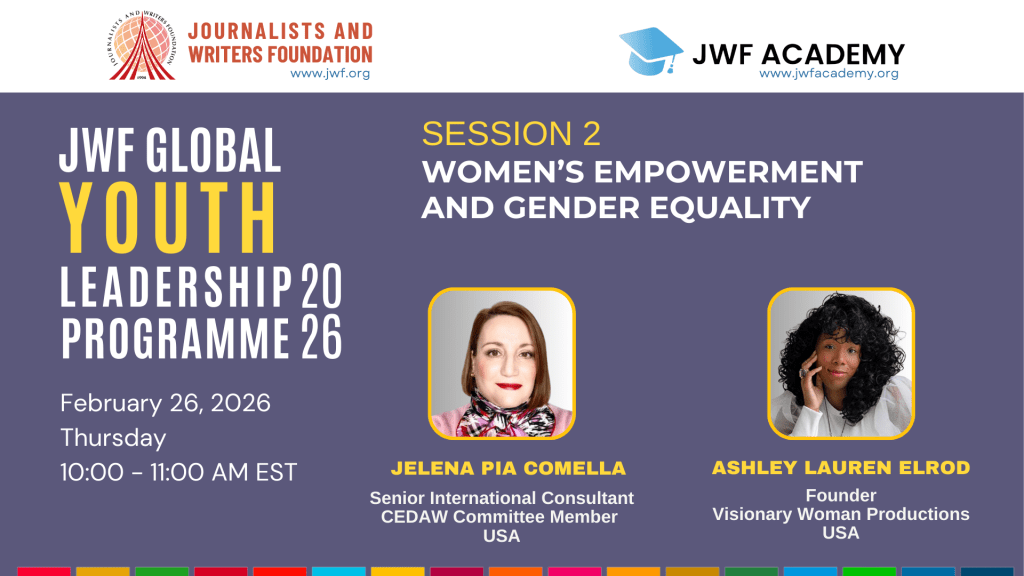
The Journalists and Writers Foundation (JWF)`s Global Youth Leadership Programme 2026 continued with its Session 2 under the theme “Women’s Empowerment and Gender Equality” on 26 February 2026, Thursday. Convening young leaders from diverse national, academic, and professional backgrounds, the session offered a timely and substantive discussion on one of the most urgent global priorities of our time: advancing the rights, leadership, safety, and full participation of women and girls in all spheres of society.
The session was framed within the wider international context of the upcoming 70th Session of the United Nations Commission on the Status of Women (CSW70), scheduled to take place at United Nations Headquarters in New York from 9 to 20 March 2026. In the opening remarks, participants were reminded that CSW remains the world’s largest annual multilateral platform dedicated to gender equality and the empowerment of women, bringing together civil society, diplomats, policymakers, experts, and advocates to influence laws, policies, funding priorities, and accountability frameworks across countries and generations. Against this backdrop, Session 2 served as an important preparatory space for young leaders to engage with the normative, institutional, and practical dimensions of gender justice.
The programme featured two distinguished speakers whose work reflects complementary yet deeply connected dimensions of women’s empowerment. Jelena Pia Comella, Senior International Consultant and Independent Member of the United Nations Committee on the Elimination of Discrimination against Women (CEDAW), offered a rigorous overview of the international normative framework underpinning women’s rights and gender equality. Drawing on her extensive experience across diplomacy, civil society, academia, and multilateral advocacy, she situated the discussion within the foundational commitments of the United Nations Charter and the broader human rights system. Her intervention underscored that the promotion of equality, non-discrimination, and women’s rights is not peripheral to the United Nations project, but central to its vision of peace, justice, and international cooperation.
 A key focus of her remarks was the significance of Sustainable Development Goal 5: Gender Equality, which calls for the achievement of gender equality and the empowerment of all women and girls. She highlighted several essential dimensions of this goal, including the elimination of all forms of discrimination against women and girls, the abolition of harmful practices such as child, early, and forced marriage, the expansion of women’s full and effective participation in leadership and decision-making, and universal access to sexual and reproductive health and reproductive rights. In this context, Ms. Pia Comella provided participants with a substantive introduction to the Convention on the Elimination of All Forms of Discrimination against Women (CEDAW), emphasizing its legal importance, its principles of equality and state obligation, and the role of the CEDAW Committee in monitoring implementation.
Her remarks also drew attention to the structural and cultural dimensions of inequality. In particular, she emphasized that gender equality cannot be achieved without confronting deeply embedded social norms, stereotypes, and hierarchies that continue to define women as inferior or secondary in many contexts. Ms. Pia Comella reflected on the importance of women’s equal participation in public and political life, including in parliaments, diplomacy, academia, civil society, and other spaces of leadership, noting that true transformation requires moving toward substantive equality in decision-making rather than symbolic inclusion.
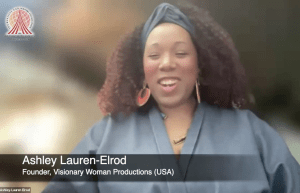 The second intervention was delivered by Ashley Lauren Elrod, Founder of Visionary Women Productions and The Reclaim Institute, and a nationally recognized survivor advocate and social impact leader. Her contribution brought a powerful survivor-informed and prevention-centered perspective to the discussion. Speaking from lived experience and professional practice, she challenged participants to think beyond visibility and representation alone, and to ask deeper questions about why empowerment so often begins only after harm has already occurred. Her remarks centered on the need to shift from reactive systems to preventive ones, especially in the protection of children and survivors, and to build cultures in which dignity, consent, safety, and agency are affirmed from the earliest stages of life.
Ashley Lauren Elrod emphasized that civil society remains one of the most important sites of social transformation. In her view, civil society is where culture begins to shift before policy catches up; it is where communities, educators, grassroots organizers, survivor advocates, storytellers, and young leaders create the conditions for systemic change. Ms. Elrod encouraged participants to understand themselves not as future leaders waiting for permission, but as present-day actors with the power to shape institutions, narratives, and public consciousness. Her intervention highlighted the importance of survivor-informed leadership, the ethical responsibility of youth in digital and civic spaces, and the need to move beyond performative empowerment toward structural protection and lasting change.
One of the most compelling dimensions of Session 2 was the participant discussion that followed the keynote addresses. Young leaders raised thoughtful and globally grounded questions on issues including the exclusion of girls from education in Afghanistan, the persistence of harmful cultural stereotypes, the challenge of building mutual understanding across different social and cultural contexts, and the importance of engaging men and boys as part of the broader struggle for gender equality. These exchanges demonstrated both the seriousness of the participants’ engagement and the relevance of the theme across different regional and political realities.
The discussion on Afghanistan was particularly poignant. A participant from Afghanistan reflected on the devastating restrictions imposed on girls’ education and asked about practical ways to support girls who feel hopeless after losing access to school, while minimizing the risks they face. In response, the session addressed the gravity of the situation and pointed to the importance of sustained international reporting, legal accountability, solidarity, and long-term advocacy. The exchange reflected how the programme creates space not only for conceptual discussion, but also for urgent reflection on lived realities and real-time global crises affecting women and girls.
Participants also explored how civil society can challenge social and cultural stereotypes that continue to restrict women’s rights and leadership. The responses emphasized the importance of local engagement, community-level organizing, media literacy, truthful storytelling, youth-led campaigns, and the creation of public forums that question normalized patterns of exclusion. The discussion further highlighted that gender equality cannot be sustained without also engaging men and boys in critical reflection, healing, responsibility, and community-based dialogue. In this sense, the session approached gender equality not as a narrow agenda, but as a broader societal project requiring structural change, cultural transformation, and shared responsibility.
Following the keynote discussion, the session transitioned into a workshop segment led by the programme coordinators. Participants were introduced to the next phase of the Global Youth Leadership Programme’s collaborative structure through thematic working groups on human rights, quality education, climate action, interfaith dialogue, global health, and economic development. The working groups were presented as practical spaces for participants to design and implement projects such as webinars, digital campaigns, policy briefs, dialogue sessions, interviews, blog articles, and collaborative research initiatives. This segment reinforced that the programme is not only an educational platform, but also a space for production, partnership, and youth-led action.
Session 2 on “Women`s Empowerment and Gender Equality” offered a rich and multidimensional engagement with women’s empowerment and gender equality. By combining international legal analysis, survivor-centered advocacy, grassroots perspectives, and active youth participation, the session underscored that gender equality must be pursued both as a normative commitment and as a lived, institutional, and cultural reality. It also reaffirmed a core message of the JWF Global Youth Leadership Programme: that meaningful youth leadership requires not only awareness of global issues, but also the courage, discipline, and collaboration to contribute to real change. As the programme continued in the coming months, Session 2 will remain an important marker of the intellectual depth and moral urgency that young leaders bring to global conversations on justice, dignity, and inclusive societies.