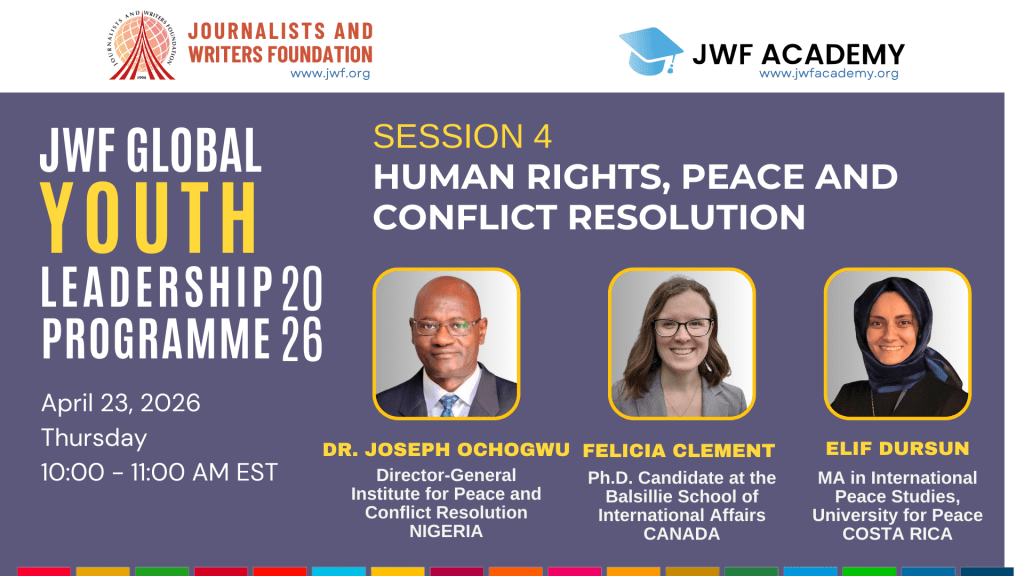
The Journalists and Writers Foundation, hosted Session 4 of the JWF Global Youth Leadership Program 2026 on 23 April 2026, under the theme “Human Rights, Peace and Conflict Resolution. The session brought together young leaders from diverse countries for an interactive and practice-oriented discussion on the relationship between human rights, sustainable peace, conflict prevention, and youth leadership. At a time when societies around the world are facing increasing polarization, shrinking civic space, violent conflict, digital misinformation, economic inequality, forced displacement, and climate-related insecurity, the session emphasized that peace cannot be achieved without justice, dignity, inclusion, and accountability.
The first speaker, Dr. Joseph Ochogwu, Director-General of the Institute for Peace and Conflict Resolution in Nigeria, opened his remarks by situating the conversation within the urgent realities of today’s world. He emphasized that human rights can no longer be understood only through traditional debates around state violence and civil liberties. Instead, contemporary human rights challenges now intersect with digital governance, climate change, economic inequality, emerging technologies, shrinking civic space, and growing tendencies toward authoritarianism.
 Dr. Ochogwu reminded participants that young people are not only beneficiaries of peace; they are also architects of peace. This framing placed youth at the center of peacebuilding and conflict transformation, not as passive recipients of policy decisions, but as active agents capable of shaping more inclusive and peaceful societies.
A central message of his presentation was that human rights and conflict resolution can no longer be treated as separate fields. In the 21st century, conflicts are increasingly multidimensional, shaped by fragile governance systems, economic marginalization, identity-based violence, climate-induced displacement, digital misinformation, and cyber manipulation. He warned that peace processes that fail to mainstream human rights often produce fragile and reversible outcomes.
Dr. Ochogwu also highlighted the evolution of human rights advocacy. He explained that advocacy has moved beyond “naming and shaming” toward data-driven accountability, grassroots and youth-led mobilization, and multi-actor governance involving governments, civil society organizations, technology firms, and local communities. This shift is particularly important for young leaders, as it shows that effective human rights work today requires evidence, collaboration, digital literacy, and community-based engagement.
Digital Rights, Climate Justice, and Emerging Drivers of Conflict
A key part of Dr. Ochogwu’s remarks focused on the need to update human rights-based approaches for contemporary realities. He emphasized that human rights now extend beyond physical spaces into digital ecosystems. In an era of online hate, surveillance abuse, misinformation, disinformation, cyber manipulation, and the ethical challenges of artificial intelligence, peacebuilding must include digital rights protection. He encouraged young people to consider how technology can either deepen conflict or become a tool for mobilization, accountability, and peace.
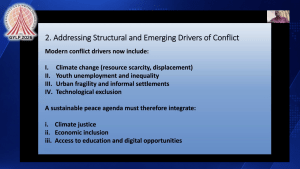
He also drew attention to structural and emerging drivers of conflict, including climate change, resource scarcity, population displacement, youth unemployment, economic inequality, urban fragility, informal settlements, and technological exclusion. These issues demonstrate that sustainable peace requires more than ending violence; it requires addressing the conditions that create exclusion, frustration, vulnerability, and instability.
For youth leaders, this message was particularly significant. Dr. Ochogwu emphasized that young people must develop personal leadership, take responsibility for their actions, and prepare themselves to lead both individually and collectively. He noted that despite global commitments, exclusion persists, yet youth movements are increasingly influencing governance and peacebuilding around the world.
Peace, Justice, and Accountability in Complex Conflicts
 Dr. Ochogwu further explored the relationship between peace and justice, asking how societies can pursue peace without accountability. He described this as one of the central tragedies of the contemporary world: the pursuit of peace while justice remains elusive. In hybrid conflicts involving states, non-state actors, insurgent groups, and digital platforms, accountability becomes increasingly complex. He raised important questions about how societies can hold both state and non-state actors accountable in asymmetric conflicts.
He highlighted several modern accountability mechanisms, including transitional justice systems, international legal institutions, community-based reconciliation, digital evidence, and open-source investigations. He stressed that the goal is not only punishment, but also truth, reparations, institutional reform, and guarantees of non-repetition. This approach places human dignity and long-term reconciliation at the center of peacebuilding.
Drawing from international examples, including Colombia, the Sahel, Eastern Europe, the Middle East, Sudan, and Nigeria, Dr. Ochogwu emphasized that peace agreements are easier to sign than to implement. He noted that meaningful peace requires victim-centered justice, gender inclusion, land reform, community engagement, and sustained institutional commitment. His concluding message was both urgent and empowering: the future of peace will not be negotiated without youth; it must be led with youth. Peace, he emphasized, is not merely the absence of violence, but the presence of justice, inclusion, and dignity.
Understanding Human Rights and the Universal Declaration
 The second speaker, Felicia Clement, a Ph.D. candidate at the Balsillie School of International Affairs / University of Waterloo, provided a foundational and accessible overview of human rights, the Universal Declaration of Human Rights, hum an rights violations, and monitoring mechanisms. She began by reminding participants that human rights are not privileges granted by states, but rights that people possess simply because they are human. She explained that human rights are fundamental, universal, inherent, indivisible, interdependent, inalienable, equal, and non-discriminatory. This framing helped participants understand that human rights are not abstract legal concepts, but essential protections tied to dignity, equality, and human existence.
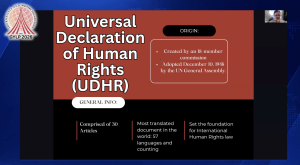
Felicia Clement then introduced the Universal Declaration of Human Rights, adopted by the United Nations General Assembly on December 10, 1948, in the aftermath of World War II. She explained that the Declaration was developed by a commission representing different political, cultural, and religious backgrounds, and that although it is not legally binding as a treaty, it became the foundational document for international human rights law and inspired the development of multiple UN human rights monitoring mechanisms. Her presentation also clarified the difference between human rights and civil rights, helping participants understand that while human rights are universal and inherent, civil rights are often tied to state obligations and legal protections within specific national systems.
Human Rights Violations Are Not Always Where We Expect Them
 One of the most powerful parts of Felicia Clement’s presentation was her discussion of human rights violations in countries that are not always commonly perceived as violators. Using Canada as an example, she discussed the ongoing lack of access to safe drinking water among some Indigenous communities. She explained that inadequate infrastructure, limited federal funding, and a history of discriminatory policies have contributed to water insecurity among Indigenous peoples. She highlighted one community in Northern Ontario that has experienced a boil-water advisory since 1995. This example encouraged participants to think critically about human rights in their own countries and communities. Rather than assuming that violations occur only in distant or conflict-affected settings, she urged young leaders to look more deeply at structural inequalities, historical injustices, and the everyday ways in which rights may be denied or neglected.
Felicia Clement also introduced participants to the main human rights monitoring mechanisms, including treaty-based bodies and charter-based bodies. She explained that charter-based bodies derive from the UN Charter and examine human rights more broadly, while treaty-based bodies monitor compliance with specific treaties that states have signed and ratified. She further explained that UN treaty bodies are composed of independent experts who receive information from governments, civil society organizations, and individuals, question governments about their human rights records, and make public recommendations for action. Through this presentation, participants gained a clearer understanding of how international human rights systems operate, why monitoring matters, and how civil society can contribute evidence, advocacy, and accountability.
Peace Education, Costa Rica, and the Practice of Living Peace
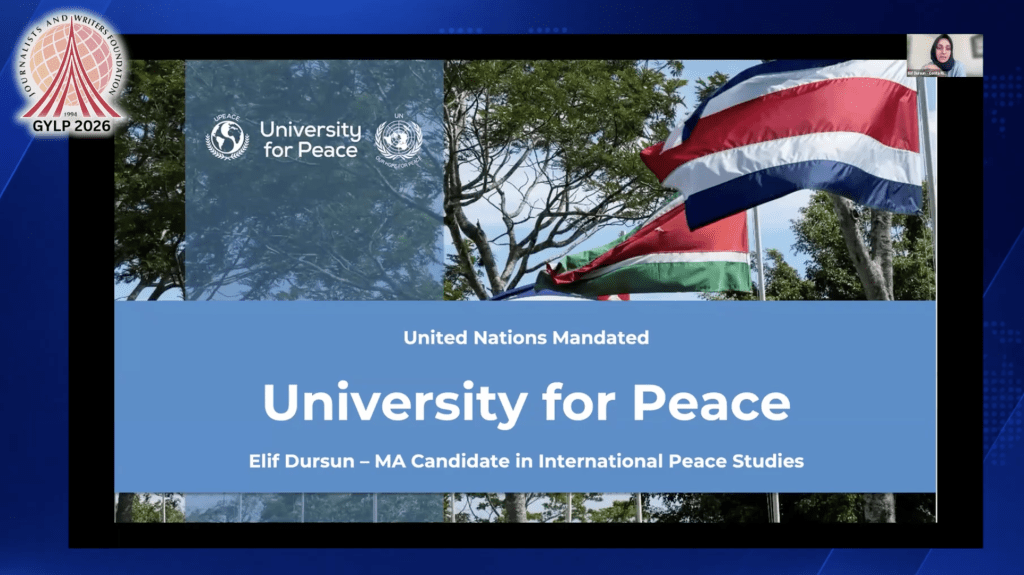
 The third speaker, Elif Dursun, joining from Costa Rica, brought a reflective and practice-based perspective on peace education, human development, and the role of learning environments in shaping future peacebuilders. Drawing from her experience at the University for Peace, she discussed Costa Rica’s unique approach to peace, emphasizing that the country chose to invest in education, health, human development, and nature instead of maintaining a standing army.
Elif Dursun emphasized that peace is not passive. It requires effort, accountability, and people who are willing to work for it. She described peace education as a shared global responsibility and highlighted the idea that if conflict has deep roots, education can also become part of the solution. Her presentation invited youth leaders to think about peace not only as a political outcome, but also as a lived practice. She described how learning in a natural, multicultural, and international environment can support reflection, connection, and dialogue. She also highlighted the global identity of peace education, noting that students, faculty, alumni, and academic partnerships can create networks that extend far beyond one campus or one country.
Importantly, Elif Dursun also offered an honest reflection on the challenges of multicultural living. She noted that living in a diverse environment means encountering different beliefs, habits, and cultural perspectives, which can sometimes lead to tension or misunderstanding. However, she framed these moments as opportunities to practice conflict resolution in real life. Her closing message was a call to young people to imagine themselves working in peacebuilding spaces, including United Nations agencies, non-governmental organizations, restorative justice education, training, and other fields connected to human rights and peace. She reminded participants that although there are critiques of international institutions, the world still needs people who are willing to work for peace.