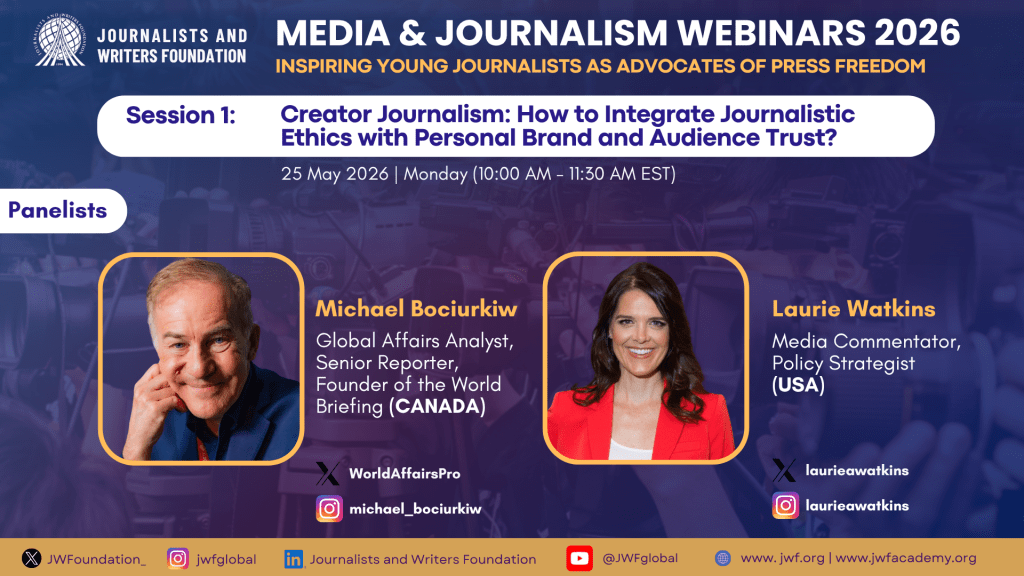
The Journalists and Writers Foundation launched the 7th Annual Media and Journalism Webinars 2026 on 25 May 2026, with Session 1 on “Creator Journalism: How to Integrate Journalistic Ethics with Personal Brand and Audience Trust?”. With its motto of “Inspiring Young Journalists as Advocates of Press Freedom,” the MJWs brought together journalism students, emerging media professionals, media educators, content creators, and young communicators from different countries for a timely discussion on the evolving role of journalism in the digital age.
As audiences increasingly move from traditional news outlets to digital platforms, independent newsletters, podcasts, social media channels, and creator-led reporting spaces, the session explored how journalists can build a visible public voice while remaining grounded in accuracy, ethics, independence, and public trust. Opening the session, Cemre Ulker, Representative of the Journalists and Writers Foundation to the United Nations Department of Global Communications, welcomed participants to the virtual certificate program and highlighted its focus on experiential, hands-on learning, mentorship, and professional development. She noted that the program brings together globally recognized journalists and media professionals across five virtual sessions to address some of the most urgent challenges facing journalism, democratic governance, and press freedom today.
In his welcome remarks, Dr. Mehmet Kilic, President of the Journalists and Writers Foundation, emphasized JWF’s commitment to promoting press freedom, ethical journalism, and the development of media professionals worldwide. He noted that the Media and Journalism Webinars have, since their inception, helped build a global network of journalists and young media professionals committed to human rights, democracy, and the right to information. Dr. Kilic further emphasized that the 2026 webinar series serve as a platform for capacity building and knowledge sharing for young journalists, journalism students, and aspiring media professionals who believe in the power of journalism to contribute to positive social change.
Session 1 has featured two distinguished speakers: Michael Bociurkiw, Global Affairs Analyst, Senior Reporter, and Founder of The World Briefing, and Laurie Watkins, Media Commentator, Policy Strategist, and Public Affairs Expert. Drawing on their extensive experience across global media, public policy, international affairs, broadcasting, and communications, both speakers offered practical guidance for young journalists navigating a rapidly changing media environment.
 Michael Bociurkiw began by acknowledging the increasingly difficult environment in which journalists operate. He noted that journalists in many countries face pressure from governments, corporate interests, conflict environments, disinformation, declining trust, and shrinking funding for independent media. Drawing from his experience in newsrooms, international reporting, humanitarian communications, and live broadcast analysis, Bociurkiw emphasized that credible journalism begins long before publication or broadcast. It begins with preparation, research, and verification.
He shared a practical example from his own work preparing for a live international television interview on the war in Ukraine. Even as an experienced commentator, he explained that he conducts background research, verifies fast-moving information, consults trusted sources, prepares talking points, and works with producers to shape the conversation before going live. This behind-the-scenes preparation, he explained, is often invisible to audiences but essential to responsible journalism. Strong interviews, especially in live broadcasting, are not improvised. They are built through careful coordination, source-checking, and editorial discipline.
One of the strongest takeaways from his remarks was the principle: “If you didn’t see it, don’t say it.” Bociurkiw encouraged participants to avoid speculation and to rely only on information they have directly observed or verified through trusted sources. In fast-moving news environments, especially during war, crisis, or political instability, this principle is central to maintaining journalistic integrity. He also reminded participants that in live broadcasting, journalists and commentators often have only one opportunity to communicate accurately. A single unverified statement can damage credibility. For young journalists, this means that preparation, caution, and accuracy must always come before speed or visibility.
A major theme in Bociurkiw’s remarks was the importance of verifying sources. He warned that today’s media environment is filled with misleading content, unfamiliar websites, manipulated narratives, and unverified social media claims. For journalists, this requires extra care and professional discipline. His message was clear: digital independence does not reduce journalistic responsibility. Whether working in a newsroom, publishing on Substack, speaking on television, or posting on social media, journalists remain accountable for the accuracy and integrity of the information they share.
Bociurkiw also addressed the growing role of artificial intelligence in journalism. He acknowledged that AI tools can support journalists in limited ways, such as generating headline options, organizing ideas, improving workflow, or assisting with editing. However, he cautioned that relying too heavily on AI to produce reporting or commentary can create ethical risks. He noted that media organizations are increasingly asking contributors to disclose whether AI was used in the development of their work. This reflects a broader professional concern around transparency, originality, accuracy, and editorial accountability.
One of the core questions of the session was how journalists can build a personal brand while remaining faithful to journalistic ethics. In the current media ecosystem, journalists are often expected to be visible, accessible, and active across multiple platforms. They may publish newsletters, appear on podcasts, build social media audiences, offer analysis, and engage directly with readers.
Bociurkiw noted that independent publishing platforms can offer meaningful opportunities for journalists to develop their voice, control their output, and build direct relationships with audiences. However, he stressed that a personal brand must be built on credibility, not performance alone.
 The second speaker, Laurie Watkins, deepened the discussion by focusing on credibility, trust, and long-term professional responsibility. Drawing on her experience across politics, policy, media, messaging, campaigns, public affairs, and commentary, Watkins reminded participants that in a noisy information ecosystem, credibility becomes a journalist’s currency. She explained that journalism is a long game. A journalist’s reputation is built over time through consistent accuracy, responsible judgment, ethical conduct, and the ability to earn trust from audiences, sources, editors, and institutions.
Watkins emphasized that credibility is what gives journalists access: access to people, stories, communities, sources, and opportunities. Without credibility, visibility has little value. For young journalists, this means that every article, post, interview, or public comment contributes to the professional reputation they are building. She reflected on her own career path, which has included government, campaigns, private sector work, public commentary, writing, and media appearances. Because her work crosses the boundaries between journalism, commentary, policy, and public communication, she emphasized the importance of maintaining clear ethical lines and practicing due diligence.
One of Laurie Watkins’ strongest messages was that fact-checking is not optional. She warned that the pressure to be first must never outweigh the responsibility to be correct. This is especially important in digital spaces, where information spreads quickly and incomplete posts can easily be misused, misinterpreted, or manipulated. Watkins discussed the risks of publishing information too quickly, particularly on social media, before a story is fully verified or properly reported. For journalists and creator journalists alike, restraint is often part of ethical practice. Sometimes credibility is protected not only by what a journalist publishes, but also by what they choose not to publish too soon. Her remarks highlighted a core principle for young journalists: speed may attract attention, but accuracy sustains trust.
Laurie Watkins also spoke about the courage required to ask difficult questions and report responsibly in polarized environments. She reminded participants that nuance is not a weakness, and that asking hard questions is not betrayal. In times of political pressure, public criticism, and online hostility, journalists must remain committed to facts, context, fairness, and accountability. She emphasized that a journalist’s personal brand should never become more important than the truth. While personal branding can help journalists build audiences and professional opportunities, it must always be grounded in integrity. If the pursuit of attention begins to compromise fairness, accuracy, or independence, public trust is weakened.
Watkins also highlighted the importance of transparency with audiences. In a fast-changing story, journalists can build trust by clearly communicating what is known, what is not yet known, and what still needs verification. Trust does not require pretending to have every answer immediately. It requires honesty, consistency, and clarity.
Supporting Young Journalists as Advocates of Press Freedom
Throughout the session, speakers and organizers acknowledged that young journalists are entering the profession at a difficult moment. The media industry is facing declining trust, funding cuts, newsroom consolidation, AI-generated content, online harassment, political pressure, misinformation, and disinformation. In some contexts, journalists also face intimidation, repression, and personal risk.
At the same time, the session emphasized that this moment also carries new possibilities. Independent platforms can help journalists reach audiences directly. Digital tools can support storytelling and global collaboration. International networks can provide mentorship, solidarity, and professional opportunities. Creator journalism can amplify underrepresented voices when practiced with responsibility and care.
The Media and Journalism Webinars aim to support young journalists by strengthening their professional skills, ethical awareness, and global networks. By connecting participants with experienced journalists and media professionals, the program creates a space for learning, mentorship, and dialogue across countries and contexts.
From Visibility to Responsibility
 Through the insights of Michael Bociurkiw and Laurie Watkins, participants were encouraged to approach journalism as a long-term commitment to credibility and public service. The session reminded young journalists that personal brand should never become more important than truth, and that the strongest media professionals are those who combine courage with discipline, independence with responsibility, and visibility with integrity.
As the Media and Journalism Webinars 2026 continue, JWF remains committed to equipping young journalists and emerging media professionals with the skills, mentorship, and global networks needed to become responsible storytellers, credible communicators, and advocates of press freedom in their communities and beyond.