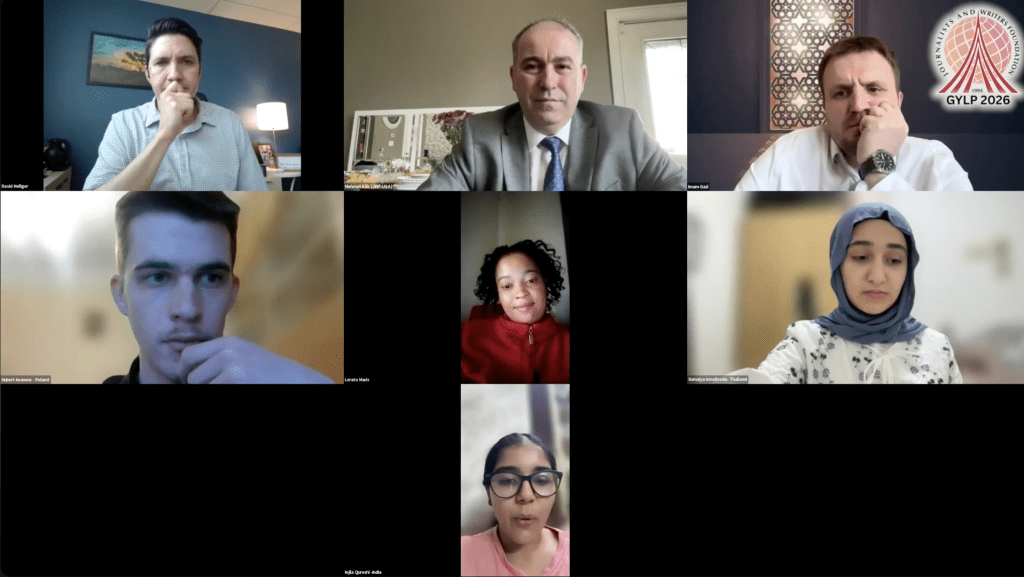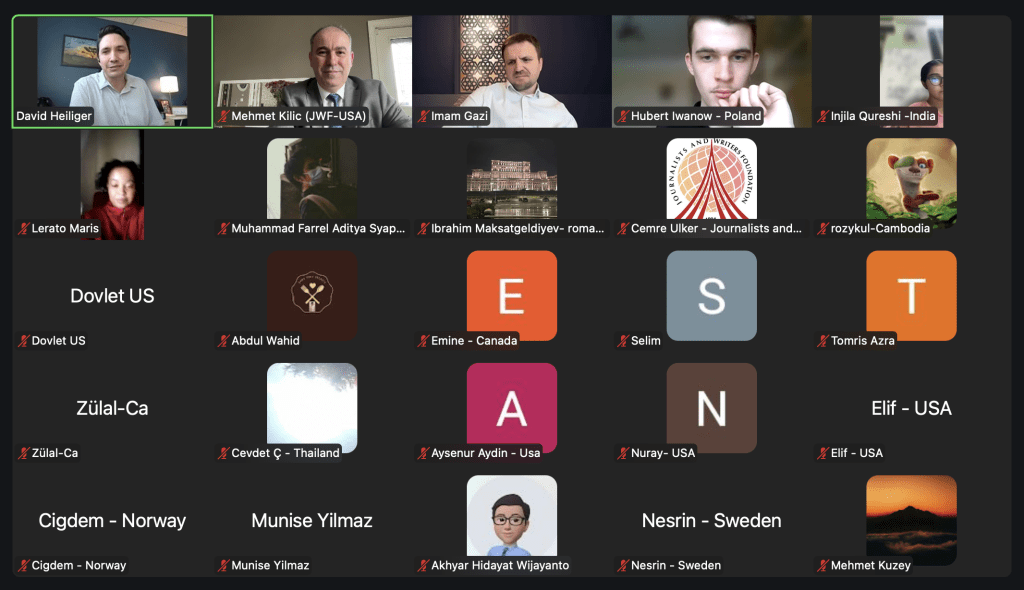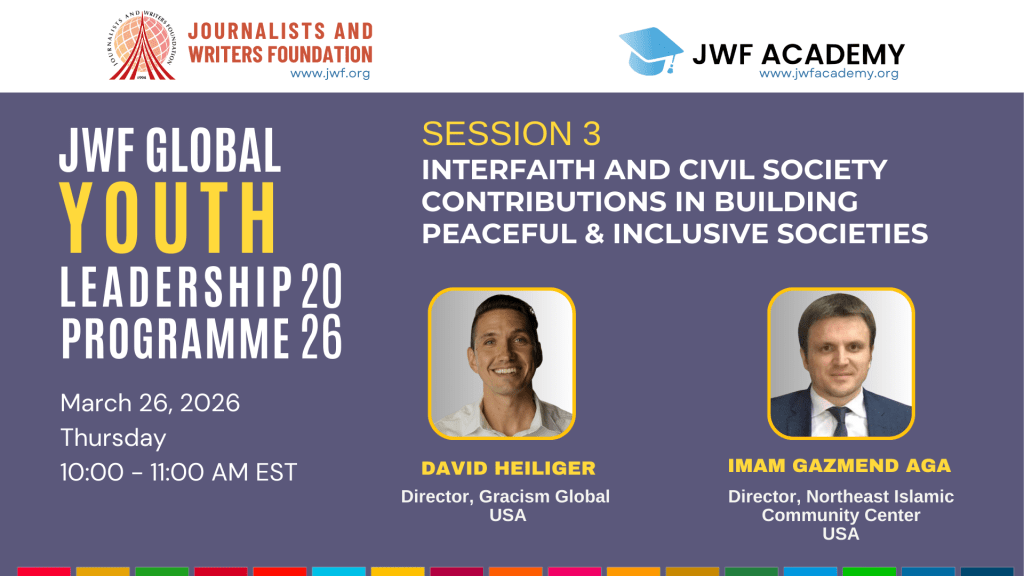
The Journalists and Writers Foundation hosted Session 3 of the Global Youth Leadership Program 2026 on 26 March 2026, under the theme “Interfaith and Civil Society Contributions in Building Peaceful and Inclusive Societies.” The session convened youth leaders from different countries and backgrounds for an interactive dialogue on the role of faith communities, civil society organizations in advancing peace, social cohesion, mutual understanding, and inclusive civic engagement. In a time marked by polarization, conflict, displacement, hate speech, and social fragmentation, the session created a meaningful platform for young leaders to reflect on how dialogue can move beyond symbolic exchange and become a practical tool for bridge-building, reconciliation, and collective action.
 In his opening remarks, Dr. Mehmet Kilic, President of the Journalists and Writers Foundation, welcomed participants joining from around the world and introduced the session as part of JWF’s broader commitment to promoting a culture of peace, human rights, and sustainable development. He emphasized that interfaith and intercultural dialogue opens avenues for listening, mutual understanding, respect for differences, and appreciation of shared humanity. He also highlighted that JWF’s work as an international civil society organization is rooted in creating spaces where diverse communities can come together not only to discuss challenges, but also to identify shared responsibilities and practical responses.
The session featured two distinguished speakers: David Heiliger, Director of Gracism Global and Pastor of Multicultural Bridge Building at Bridgeway Community Church, and Imam Gazmend Aga, Director of the Northeast Islamic Community Center. Through personal stories, practical frameworks, and reflections from their peacebuilding work, both speakers invited participants to think deeply about how interfaith engagement can help transform divided communities into spaces of trust, dignity, and cooperation.
Dialogue as a Response to Division
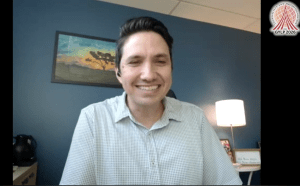 Opening his presentation, David Heiliger invited participants to reflect on a central question: “What do you believe is the greatest cause of division in the world?” Participants responded with words and ideas such as politics, inequality, lack of communication, geopolitics, ideology, power, self-interest, historical conflict, and lack of understanding. Mr. Heiliger used these responses to emphasize a shared reality: regardless of how people explain division, most people recognize that division is present in their communities, societies, and relationships.
He encouraged youth leaders to examine how division operates not only at the level of global conflict, but also in everyday human relationships: the creation of “us” and “them,” the distancing of one group from another, and the tendency to view people across religious, cultural, or political divides as outsiders. He reminded participants that when communities remain distant from one another, misunderstanding can easily become fear, and fear can become hostility. Against this background, David Heiliger introduced the concept of bridge leadership. He asked participants to consider whether they are becoming bridge builders or bridge burners, and more importantly, what they are actively doing to strengthen their ability to counter division. He presented four essential qualities of a bridge leader: curiosity, empathy, action-orientation, and intentionality. According to Heiliger, these qualities are necessary for those who wish to move beyond passive concern and become active contributors to peace.
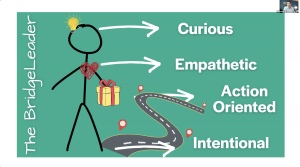 He described curiosity as the willingness to approach others with genuine interest rather than judgment. In interfaith and intercultural dialogue, curiosity is not merely about asking questions; it is about asking with humility, openness, and positive eagerness to understand what exists on the other side of a divide. This kind of curiosity allows young leaders to move beyond stereotypes and encounter others as human beings with histories, hopes, values, and dignity. Mr. Heiliger also emphasized that dialogue must lead to action. He introduced the concept of “gracism” as the extension of positive favor toward others, particularly across lines of color, class, culture, and religion. He explained that bridge-building is not only about having meaningful conversations; it also requires offering concrete gestures of goodwill, protection, service, and solidarity.
One of the most powerful moments of the session came when Heiliger shared the story of a community that experienced religious violence, including the burning of churches. After receiving resources through a justice process, members of the affected Christian community chose not only to rebuild their own churches but also to build a water sanitation plant serving the wider community, including people across the religious divide. This act of service became a visible example of peacebuilding through action. At the ribbon-cutting ceremony, both the community that built the plant and members of the wider community, including those previously associated with hostility, were present. Heiliger described this as a “gift of bridge building,” showing that acts of generosity and shared service can create new possibilities for relationship even after deep harm.
Interfaith Dialogue as a Moral and Civic Responsibility
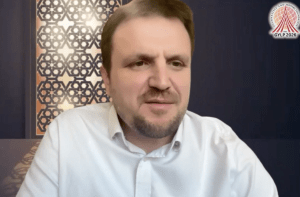 Following Heiliger’s presentation, Imam Gazmend Aga offered reflections on the urgency of peacebuilding in today’s global context. He emphasized that peacebuilding should not be understood as the responsibility of institutions alone, but as a moral obligation for every individual, including students, parents, neighbors, religious leaders, and community members. In his remarks, he underlined that in a world facing armed conflict, displacement, polarization, and fear, peacebuilding is no longer optional; it is necessary for the protection of human dignity and shared rights.
Imam Aga explained that interfaith dialogue is often misunderstood. He clarified that dialogue does not mean abandoning one’s beliefs, weakening one’s religious identity, debating for superiority, or attempting to convert others. Rather, interfaith dialogue is a process of coexistence, dialogue, collaboration, and reconciliation. This framing helped participants understand that authentic dialogue does not require people to erase their differences. Instead, it allows communities to remain rooted in their own traditions while learning how to live peacefully, respectfully, and constructively with others.
He encouraged young leaders to know their own religious and cultural roots deeply, noting that a stronger understanding of one’s own tradition can actually strengthen the motivation for interfaith dialogue. He reflected that every faith tradition, at its core, carries a desire for peace and the moral formation of human beings. Drawing on historical examples, including models of pluralism and coexistence, he invited participants to see interfaith engagement not as a new or abstract concept, but as a practice with deep roots in human history.
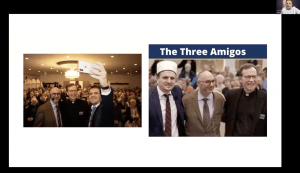 A key theme in Imam Aga’s remarks was the importance of breaking isolation. He noted that many people are not exposed to interfaith dialogue or to meaningful diversity in their daily lives. Without such exposure, communities can remain trapped in assumptions, fear, and inherited prejudice. Interfaith initiatives can help remove these barriers by creating opportunities for people to meet one another, share meals, visit each other’s spaces, ask questions, and build trust. He also encouraged youth participants not to underestimate their own power. He reminded them that even small initiatives can help communities learn more about one another, reduce barriers, and contribute to lasting and transformative peace.
From Dialogue to Relationship, Trust, and Collective Action
The session concluded with an interactive Q&A discussion, where youth participants raised thoughtful questions about what comes after interfaith dialogue has been established in a community. One participant asked how dialogue creates real benefit after relationships have already begun. Responding to this question, Imam Aga explained that one of the first outcomes of interfaith dialogue is the formation of genuine friendships. He reflected that people who may have lived in the same town, visited the same public spaces, or passed one another in everyday life can begin to see one another differently after sharing values, culture, and events together. Through dialogue, strangers become neighbors, and neighbors can become allies.
He further explained that interfaith dialogue can help members of each community understand their own faith more deeply. By encountering others, people may gain a clearer sense of their own beliefs, values, and responsibilities. He also noted that interfaith relationships can create protection in times of tension. When a community is attacked or misrepresented, others who have built relationships with them may be more likely to speak up, reject stereotypes, and defend their dignity. He gave the example of Muslims, Christians, Jews, priests, and rabbis supporting one another in local community life and civic processes.
David Heiliger added that the value of interfaith dialogue lies not only in friendship, but also in the way relationships shape decision-making. He emphasized that when people have shared meals, visited one another’s homes, or built real connections, they are less likely to make decisions based on abstract stereotypes. Instead of thinking about “that religious group” as a distant category, leaders begin to see names, faces, families, and lived experiences. Heiliger explained that what comes after dialogue is relationship — and relationship creates deeper consideration when decisions are made. This discussion underscored one of the most important insights of the session: interfaith dialogue is not an endpoint. It is a beginning.
It’s true impact is seen when dialogue becomes relationship, relationship becomes trust, and trust becomes collective action for the common good.

Youth Leadership for Peaceful and Inclusive Societies
Throughout the session, participants were encouraged to see themselves not only as learners, but as emerging peacebuilders and civil society actors. The speakers emphasized that youth have a critical role to play in countering division, challenging prejudice, and creating inclusive spaces in their own communities. The discussion also aligned closely with the broader objectives of the JWF Global Youth Leadership Program, which brings together young leaders from diverse countries to explore global challenges, strengthen leadership skills, and develop collaborative initiatives in areas such as education, climate, health, economy, and interfaith dialogue. The session reaffirmed the importance of empowering young people to become active contributors to peace, rather than passive observers of conflict.
By focusing on interfaith and civil society contributions, the session highlighted that peaceful and inclusive societies are not built only through policies or institutions. They are also built through everyday acts of listening, hospitality, moral courage, service, and solidarity. Faith communities and civil society organizations can play a vital role in this process by creating spaces where people can encounter difference without fear, address tensions constructively, and work together across lines of identity.
The session concluded with a call for young leaders to take initiative in their local contexts. Whether through dialogue circles, community service projects, interfaith visits, storytelling campaigns, youth-led discussions, or collaborative civic action, participants were encouraged to translate the lessons of the session into practical steps. As part of the JWF Global Youth Leadership Program 2026, this session reaffirmed the urgent need for a new generation of bridge builders: young people who are curious enough to listen, empathetic enough to care, courageous enough to act, and intentional enough to build peaceful and inclusive societies.