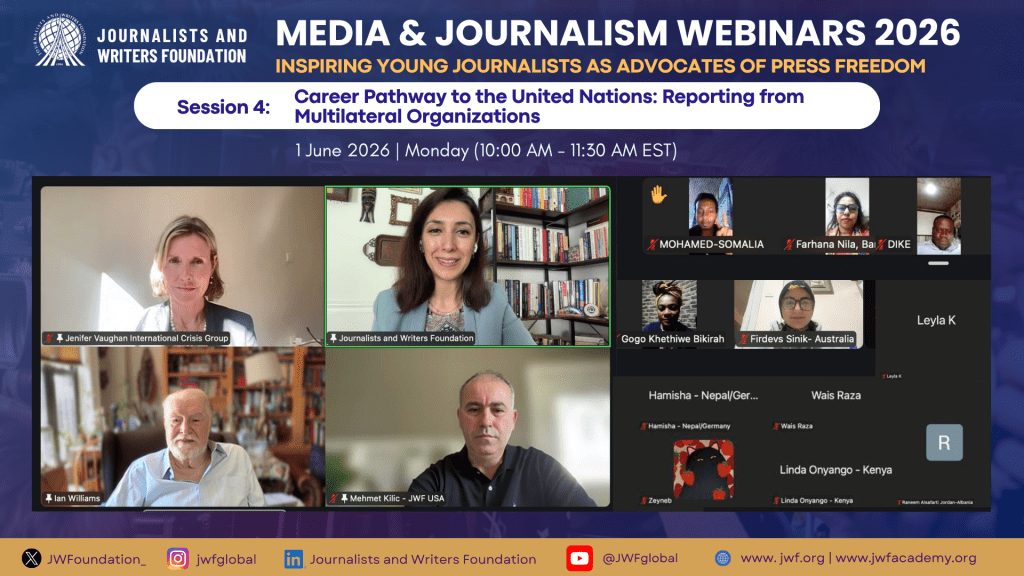
The Journalists and Writers Foundation hosted the fourth session of the 7th Annual Media and Journalism Webinars 2026 on June 1, 2026, under the theme “Career Pathway to the United Nations: Reporting from Multilateral Organizations.” Held as part of the broader webinar series “Inspiring Young Journalists as Advocates of Press Freedom,” the session brought together young journalists, journalism students, emerging media professionals, and communications practitioners from different countries to explore professional pathways in international reporting, United Nations coverage, and multilateral journalism.
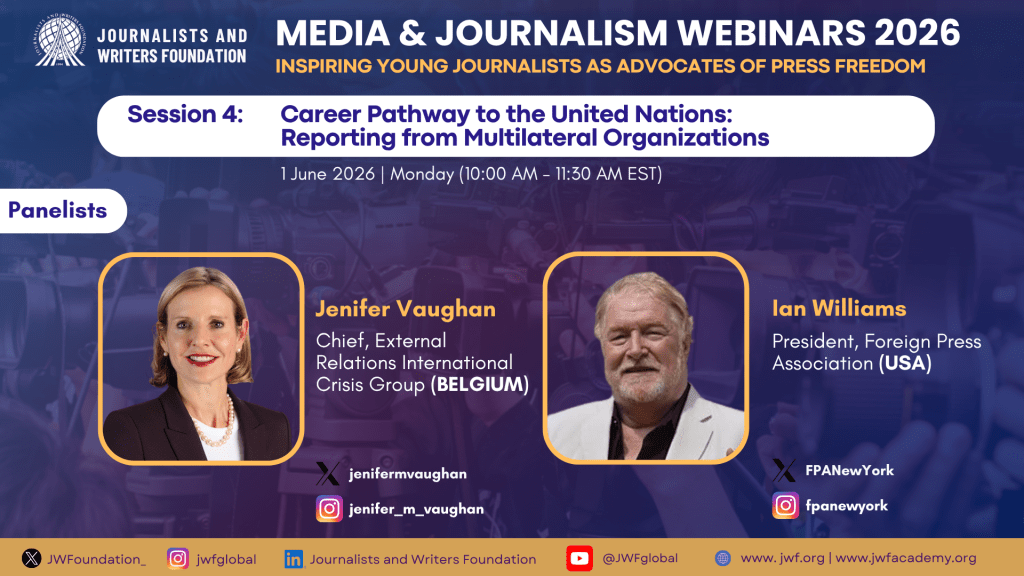
The session examined how aspiring journalists can build careers at the intersection of media, diplomacy, international affairs, human rights, humanitarian action, and global governance. Speakers reflected on the skills, ethical responsibilities, institutional knowledge, and professional networks required to report effectively from the United Nations and other multilateral organizations. The session featured two distinguished speakers: Jenifer Vaughan, Chief of External Relations at the International Crisis Group, and Ian Williams, President of the Foreign Press Association in the United States.
 The first speaker, Jenifer Vaughan, drew from her extensive career across journalism, diplomacy, academia, and multilateral communications. Her professional background includes senior roles at CNN and Al Jazeera, as well as United Nations work with the Office for the Coordination of Humanitarian Affairs, UNHCR, and the office of the UN Special Envoy for Syria. She also served as a Poynter Fellow in Residence at Yale University and recently joined the International Crisis Group as Chief of External Relations.
Vaughan opened her remarks by noting that there are many different entry points into United Nations reporting. She encouraged participants to identify pathways that align with their interests, level of journalism experience, and location. She explained that UN coverage can look very different depending on geography: New York often focuses on the Security Council, high-level politics, and the General Assembly, while Geneva is more closely associated with humanitarian law, human rights, refugee issues, and global health.
At the same time, Vaughan emphasized that the United Nations is not only New York or Geneva. Its work extends across field offices, peacekeeping missions, humanitarian operations, and crisis-affected settings around the world. For journalists, this means that UN stories are often found not only in headquarters, but also in places such as conflict zones, refugee-hosting regions, humanitarian response sites, and communities directly affected by global policy decisions.
She encouraged young journalists to build both subject expertise and institutional knowledge. The UN covers a wide range of issues, including global health, climate change, refugee protection, forced displacement, peace and security, gender equality, youth, and humanitarian response. Rather than trying to cover everything, Vaughan advised participants to develop depth in at least one area of interest and understand how that topic intersects across multiple parts of the UN system.
One of Vaughan’s key pieces of advice was to read UN documents carefully. She noted that the UN produces an enormous volume of public documentation, including Security Council programs, country reports, internal oversight investigations, treaty body reports, and humanitarian updates. These documents often contain valuable information that many journalists, and even some people inside the UN system, may not fully use.
Vaughan emphasized that journalists who want to cover multilateral organizations should learn how to follow documents, funding flows, mandates, and institutional processes. UN reporting often rewards persistence more than speed. While daily news moves quickly, institutional stories can unfold over months or years. Journalists who follow a single issue consistently, such as peacekeeping accountability, humanitarian funding gaps, institutional impunity, or refugee protection, can build strong credibility and a solid professional reputation.
Her remarks encouraged young journalists to see UN reporting not only as event-based coverage, but as sustained public-interest journalism. The most important stories may not always be found in official press releases. They may emerge from patterns in documents, gaps between pledges and implementation, or the consequences of decisions made far from the communities they affect.
Vaughan also addressed the ethical challenges of reporting from multilateral organizations. She explained that multilateral settings involve competing interests among member states, UN agencies, donor governments, diplomatic missions, humanitarian organizations, and affected populations. This can create pressure on journalistic objectivity and requires careful framing. She warned that official UN language is not always neutral. Terms such as “grave concern,” “deeply troubled,” or “calls upon” may sound formal and diplomatic, but journalists must translate such language into plain terms and explain what it means in practice, especially when statements are not followed by action.
A major point in her remarks was the difference between impartiality and false balance. Vaughan emphasized that reporting both sides of a dispute does not automatically make coverage fair or accurate, especially when one side is a well-resourced state actor and the other is a marginalized population. Impartiality requires proportionality, context, and evidence. It should not become equivalence that distorts reality.
She also reminded participants that multilateral journalism can sometimes normalize inaction. The UN holds summits, passes resolutions, and convenes pledging conferences, but journalists must also ask whether commitments are kept, whether funding is delivered, and whether affected communities see real change. In this sense, accountability and follow-up are essential parts of multilateral reporting.
Vaughan emphasized that humanitarian reporting requires a higher duty of care because the people at the center of these stories are often among the most vulnerable in the world. Journalists must consider whether naming individuals, identifying locations, publishing images, or revealing certain details could put people at risk. She noted that the consequences of error in humanitarian reporting are not abstract. They can affect survivors, displaced communities, refugees, detainees, and people living under conflict or repression. Therefore, verification must be paired with dignity, consent, and risk assessment.
Vaughan also discussed visual journalism, noting that images of suffering, displacement, and death carry enormous editorial power, but can also strip subjects of dignity or agency if used carelessly. She encouraged young journalists to understand the visual ethics policy of their outlet, or to follow global standards before reporting in humanitarian settings. This section of the discussion underscored that reporting from multilateral organizations is not only about access to diplomats or institutions. It is also about responsibility toward the people whose lives are shaped by international decisions.
Vaughan offered practical guidance on navigating press briefings, accreditation systems, and professional relationships with diplomats and UN officials. She emphasized that understanding accreditation deadlines is crucial, since missing them can prevent journalists from accessing important meetings, briefings, embargoed documents, or high-level events. She also encouraged participants to understand the mandates of specific UN agencies before approaching them. For example, UNICEF focuses primarily on children, UNHCR on refugees and forced displacement, IOM on migration, and OCHA on humanitarian coordination. Knowing institutional mandates helps journalists ask better questions and reach the right sources.
Vaughan noted that spokespersons can be valuable guides within the UN system, especially because they often understand how agencies, field offices, and headquarters connect. Building professional relationships with spokespersons, press officers, diplomats, field staff, NGOs, and humanitarian organizations can help journalists navigate complex systems and find reliable information. She also encouraged journalists to build relationships across the full diplomatic spectrum, not only with the five permanent members of the Security Council. Elected Security Council members, small island states, regional groups, and smaller delegations can often provide important perspectives and may be more accessible or candid on specific issues.
Her closing advice was grounded in professional reliability: if journalists promise to send questions, offer a right to respond, or agree not to use certain information, they must keep their word. In the UN system, reputations are built through many small interactions, and the most trusted correspondents are often those known to be fair, reliable, and consistent.
Reporting on the UN with Independence and Accountability
 The second speaker, Ian Williams, brought decades of experience as an author, journalist, broadcaster, and longtime observer of the United Nations. As President of the Foreign Press Association in the United States and a former President of the United Nations Correspondents Association, Williams has reported from more than 60 countries and has trained journalists in several regions.
Williams reflected on how UN press relations have changed over time, recalling that in earlier years parts of the UN bureaucracy were highly resistant to the press. He emphasized that journalists serve an important public duty by exposing waste, mismanagement, corruption, and institutional failures. In his view, reporting on such issues does not weaken the UN; rather, it gives institutions an opportunity to correct problems and restore credibility.
He reminded participants that both diplomats and journalists have agendas, pressures, and institutional constraints. Therefore, journalists must approach all sources critically. While powerful delegations may provide useful information, smaller non-permanent delegations can sometimes offer more candid insight into what is happening behind closed doors. Williams emphasized the importance of knowing sources while also maintaining healthy skepticism toward all of them. Williams also stressed that the UN can be difficult to cover if journalists only focus on headquarters processes. The institution becomes more meaningful when reporting connects decisions in New York or Geneva to realities on the ground. Field perspectives, resident representatives, local experts, civil society actors, and affected communities can help journalists understand what multilateral decisions actually mean in practice.
Williams offered a candid reflection on the realities of a journalism career, especially in a period of digital disruption, declining salaries, shrinking job security, and increasing pressure on traditional media. While he acknowledged that journalism can be a remarkable profession that opens doors to world leaders, diplomats, CEOs, communities, and global events, he also warned participants to be realistic about the financial and professional challenges of the field.
His remarks balanced inspiration with realism. Journalism can offer access, purpose, and the chance to shape public understanding, but it often demands persistence, independence, resilience, and a willingness to navigate uncertainty. For young journalists interested in international affairs, this means building skills, networks, credibility, and subject expertise while remaining aware of the economic realities of the profession. Williams also emphasized the importance of independent judgment. Journalists must be willing to challenge dominant narratives, resist pressure from editors or political actors, and recognize when a story has been inflated or distorted. Sometimes, he noted, a journalist’s role is not only to expose wrongdoing, but also to identify when a supposed scandal lacks substance.
Across both presentations, the session highlighted that reporting from multilateral organizations is a form of public service. It requires journalists to translate complex institutional language, follow slow-moving processes, examine funding and implementation gaps, and explain how global decisions affect people’s lives.
The discussion also emphasized that UN reporting is not only about diplomacy. It is about power, accountability, human rights, humanitarian protection, public finance, conflict prevention, climate displacement, peacebuilding, and the dignity of affected communities. For young journalists, the session offered a practical roadmap: build expertise, read documents, follow the money, understand mandates, cultivate sources, verify carefully, avoid false balance, and remain accountable to the people whose stories are being told.
Preparing Young Journalists for Global Reporting
The fourth session of the Media and Journalism Webinars 2026 reaffirmed JWF’s commitment to equipping young journalists and emerging media professionals with the knowledge, ethical grounding, and mentorship needed to report on international affairs and multilateral institutions.
Through the insights of Jenifer Vaughan and Ian Williams, participants gained a deeper understanding of how to approach United Nations reporting with professionalism, independence, and responsibility. The speakers encouraged participants to see the UN not only as an institution, but as a global arena where diplomacy, politics, humanitarian needs, funding decisions, and human rights concerns intersect. As the Media and Journalism Webinars 2026 continue, JWF remains committed to supporting young journalists as advocates of press freedom, ethical reporting, and responsible public communication. The session concluded with a clear message: effective reporting from multilateral organizations requires not only access and ambition, but also patience, credibility, ethical judgment, and a sustained commitment to truth.