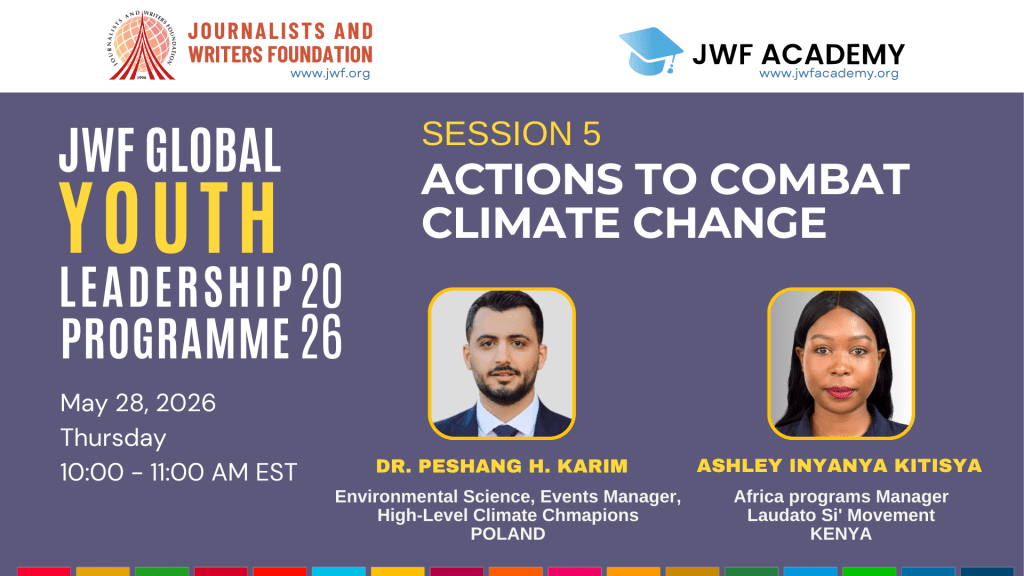
The Journalists and Writers Foundation hosted Session 5 of the JWF Global Youth Leadership Program 2026 on May 28, 2026, under the theme “Actions to Combat Climate Change.” The session brought together young leaders from across the world for an interactive and action-oriented dialogue on climate leadership, youth participation, environmental justice, and sustainable solutions. At a time when climate change continues to intensify inequalities, disrupt livelihoods, displace communities, and threaten ecosystems, the session emphasized the urgent need to move from awareness to implementation, and from discussion to concrete climate action.
The session featured two distinguished speakers: Dr. Peshang H. Karim, environmental scientist, and Water Solutions Lead with the High-Level Climate Champions from Poland, and Ashley Inyanya Kitisya, Africa Programs Manager at the Laudato Si’ Movement from Nigeria. Both speakers brought rich experience from climate advocacy, international negotiations, grassroots mobilization, environmental justice, and youth-led climate engagement.
Youth Participation in Climate Decision-Making
 The first speaker, Dr. Peshang H. Karim, opened his remarks by focusing on the importance of youth participation and inclusion in climate decision-making processes, both inside and outside the United Nations system. He reminded participants that climate negotiations are often long, technical, and difficult processes, but that the future of humanity depends on the decisions made in these spaces. Dr. Karim emphasized that many climate decisions are still made behind closed doors by older decision-makers, while young people and children will live with the long-term consequences of those decisions. For this reason, he argued that youth inclusion and accountability are essential, not symbolic. Young people must not only be invited into climate spaces; their ideas, visions, and demands must meaningfully shape policies and implementation.
Reflecting on his own journey, Dr. Karim shared how this concern led him to become involved in the UN climate process and to participate in international climate conferences, including the Conference of Parties and youth climate platforms. He explained that participation alone is not enough. Young climate advocates must enter these spaces with clear agendas, policy priorities, and collective demands. Through platforms such as YOUNGO, the official children and youth constituency of the UNFCCC, young people are able to organize, prepare policy papers, develop declarations, and present youth demands to world leaders.
His remarks underscored an important lesson for youth leaders: climate advocacy requires preparation, coordination, persistence, and strategy. In large international spaces where thousands of people participate, young people can easily be overlooked unless they organize collectively, build shared positions, and advocate consistently.
From Declarations to Implementation
A central theme in Dr. Karim’s presentation was the need to move beyond declarations and pledges toward implementation. He acknowledged that youth demands are not always immediately adopted by world leaders, especially because climate decision-making is shaped by political, economic, and geopolitical interests. However, he also emphasized that youth advocacy is never wasted. Persistent engagement, lobbying, bilateral meetings, policy recommendations, and public pressure can help shift narratives, influence declarations, and create openings for greater youth inclusion.
Dr. Karim also spoke about his work with the Climate High-Level Champions, explaining that the goal is to better align and strengthen the role of non-state actors, including civil society organizations, NGOs, academia, local communities, and the private sector. He emphasized that non-state actors bring real-world experience, community-based knowledge, and practical solutions into climate action spaces. He stressed that the world already has many climate pledges, but what is urgently needed is visible implementation. Climate action must move from conference statements to local realities, from commitments on paper to measurable change in communities. He described this shift as essential in a period increasingly defined as a time for implementation.
Lessons from COP30 and the Climate Action Agenda
Dr. Karim shared reflections from his participation in COP30 in Belém, Brazil, describing the conference as a vivid reminder of the urgency of climate action. He noted that participants experienced storms, fire, and visible frustration from vulnerable local communities who felt unheard in global climate spaces. These experiences illustrated the gap between high-level climate discussions and the lived realities of communities on the frontlines of climate change.
He then discussed the six axes of the climate action agenda announced around COP30, which focused on: energy, industry, and transport; forests, oceans, and biodiversity; agriculture and food systems; resilience for cities, infrastructure, and water; human and social development; and enabling factors such as finance, technology, and capacity building. These axes, he explained, were designed to accelerate real solutions across sectors and connect climate goals to practical pathways for implementation.
Dr. Karim emphasized that the major question is no longer simply whether solutions exist. The world already knows many of the technical solutions, including renewable energy, climate-resilient infrastructure, sustainable agriculture, and water solutions. The deeper question is how to implement those solutions across homes, communities, businesses, institutions, and local economies. His closing message was clear and urgent: young people must become part of the solution, not part of the problem. He called on participants to join organizations, take part in local, regional, and global initiatives, and act now because the climate crisis cannot wait for slow political cycles.
Environmental Justice, Faith Communities, and Youth-Led Transformation
The second speaker, Ashley Inyanya Kitisya, Africa Programs Manager at the Laudato Si’ Movement, brought a powerful justice-centered and community-based perspective to the discussion. She began by reminding participants that the world is living through a defining decade shaped by technology, geopolitics, and worsening climate impacts, including droughts and displacement across Africa and beyond. Ashley emphasized that young people are not only future leaders; they are already organizers, innovators, advocates, and solution-builders. She noted that youth movements have evolved significantly because of grassroots action, where young people are no longer waiting for permission to participate. Instead, they are demanding space in decision-making processes that directly affect their futures.
Drawing from her experience at COP30, Ashley discussed the importance of bringing an ethical and moral lens to climate action. As someone working within a faith-based organization, she highlighted the role of faith communities in asking deeper questions about justice, responsibility, and human dignity. She emphasized that climate decisions must center people and communities, especially those on the frontlines who are often absent from formal decision-making spaces.
Fossil Fuel Phase-Out, Just Transition, and Accountability
 One of Ashley’s key reflections focused on the growing global conversation around fossil fuel phase-out and just transition. She explained that moving away from oil and gas is essential because fossil fuels remain a major driver of the climate crisis. However, this transition must be fair and context-sensitive. Countries and communities must not be forced into transition pathways that ignore their economic realities, energy needs, or development challenges.
She described the outcomes of COP30, including processes connected to implementation beyond COP30 and discussions on fossil fuel transition, as important steps forward. At the same time, she emphasized that commitments are only meaningful when followed by accountability at national and community levels. This is where youth-led initiatives become crucial: young people can track progress, raise awareness, document community needs, and amplify grassroots voices. Ashley stressed that every young person could begin with an action in their own community. Whether through advocacy, education, monitoring, storytelling, research, policy engagement, or local organizing, youth can help ensure that climate commitments translate into meaningful change.
Collaboration, Capacity Building, and Long-Term Climate Leadership
A major theme in Ashley’s remarks was collaboration. She shared that one of the lessons from her own experience, including as a 2024 alumna of the JWF Global Youth Leadership Program, is that collaboration continues long after a program ends. Networks built through youth leadership programs can become long-term sources of mentorship, partnership, and mutual support. She encouraged participants to invest in capacity building, continuous learning, and credible knowledge. In a time when climate information is abundant but misinformation is also widespread, young advocates must become reliable, grounded, and informed voices in their communities.
Ashley also highlighted the importance of working with youth organizations to access funding, mentorship, and technology. She noted that meaningful youth engagement requires trust, transparency, and willingness to share power. Youth participation should not be an afterthought; it must be embedded into planning, decision-making, and implementation strategies from the beginning. She also acknowledged the systemic barriers that limit youth participation, including unemployment, digital divides, lack of mentorship, and unequal access to climate spaces. Addressing these challenges requires inclusive participation, stronger support systems, and sustained investment in young people.
Her message to participants was both practical and inspiring: your voice matters, and your action matters even more. She urged youth leaders to start where they are, with what they have, while remaining grounded in justice, courage, hope, and long-term commitment.
Climate Action Must Be Rooted in Justice and Community
 During the Q&A session, participants raised questions on international climate law, the Paris Agreement, climate accountability, Indigenous representation, and grassroots participation. The discussion highlighted the complexity of climate governance and the limits of state-led processes, especially when countries withdraw from agreements or fail to meet their obligations.
Ashley emphasized that although international climate processes are largely state-led, young people and civil society can continue advocating through other channels, including international legal bodies, regional organizations, community-led discussions, and social media. She noted that climate accountability is becoming increasingly important and that a clean environment is increasingly recognized as a human rights issue.
Participants also asked how global climate initiatives can ensure that Indigenous peoples and grassroots communities are meaningfully represented in decision-making. Dr. Karim responded by highlighting the importance of climate finance, transparency, and the need for the Global North to support communities in the Global South that contribute least to climate change but face some of its harshest consequences. He discussed the importance of climate finance mechanisms, including the role of the Green Climate Fund and the need to channel resources transparently and effectively to those most affected.
This exchange reinforced one of the session’s most important insights: climate action must be grounded in justice. Those who are most affected by climate change — Indigenous peoples, local communities, youth, women, small island communities, rural populations, and vulnerable groups — must not be treated only as victims. They must be recognized as knowledge holders, leaders, partners, and decision-makers.
Youth Leadership for a Sustainable Future
 Across both presentations and the Q&A discussion, a shared message emerged: climate action requires more than concern. It requires leadership, organization, accountability, collaboration, and courage. The speakers encouraged young leaders to move beyond awareness campaigns alone and toward concrete action. This includes participating in climate working groups, developing policy proposals, engaging with local communities, strengthening climate literacy, building partnerships, tracking government commitments, advocating for just transition, and supporting grassroots solutions.
The session also emphasized that climate change is not only an environmental issue. It is connected to human rights, economic justice, public health, migration, food systems, water security, peace, and intergenerational equity. For young leaders, this means climate action can happen across many fields — law, policy, education, media, technology, faith communities, research, advocacy, and community organizing.
From Climate Concern to Climate Action
 The fifth session of the JWF Global Youth Leadership Program 2026 reaffirmed the importance of empowering young people as climate leaders and sustainability advocates. Through the insights of Dr. Peshang H. Karim and Ashley Inyanya Kitisya, participants were encouraged to see themselves not as observers of the climate crisis, but as active contributors to climate solutions. The session highlighted that the future of climate action depends on meaningful youth participation, ethical leadership, strong partnerships, climate justice, and implementation at every level. It also underscored that global climate commitments must be connected to local realities, especially for communities most affected by climate change. As part of JWF Academy’s broader mission to strengthen youth leadership for sustainable development, this session encouraged participants to act with urgency, build across communities, remain grounded in justice, and contribute to a more resilient and sustainable future for all.