The Role of Journalism in Creating Stable Societies

screen-shot-2022-06-07-at-9-07-42-pm
session-2

July 27, Wednesday (11:00 AM - 12:30 PM EST)

Media and Journalism Webinars emphasize experiential and hands-on learning through intensive training and interactive discussions with professional journalists for field experience. This program aims to prepare journalism students and young professionals to succeed in their professional careers while fostering experiential learning by translating knowledge and skills into experience.


In this session, participants will be able to learn about the following topic and subjects from professional journalists and media personalities. Your active and meaningful participation with questions and reflections will make the discussion more productive.  


The Role of Journalism in creating Stable Societies

  1. Supporting vibrant civil society and fundamental rights
  2. Journalism for social good: role of media in strengthening social fabric and stability
  3. Journalists being a part of the solution or the problem: roles and responsibilities
  4. Journalists as public opinion builders and stewards of democracy and human rights
  5. Rebuilding local news while empowering the needs of society

Guest Speakers

Uday Basu

Chair, International Association of Religion Journalists, India

speakers_0000_uday-basuUday Basu is the Chair of the International Association of Religion Journalists (IARJ). He has been in journalism for over 40 years working in different capacities in The Statesman, a leading daily of India founded by the British in the late 19th century. Mr. Basu was the paper’s Editor for several years. Uday Basu has written extensively on politics, religion, administration, education, and culture. He has many scoops under his belt, including one on the resignation of a Marxist Chief Minister of Bengal. Mr. Basu was faculty of The Statesman School of Print Journalism. Now, he writes Editorials for an English daily of eastern India, The Orissa Post. Uday Basu also wrote a book, Left Out In Bengal, that traces the rise and fall of the Marxist government in Bengal.

Dr. Rajendran Govender

Social Cohesion Advocate, Newspaper Columnist, South Africa

whatsapp-image-2022-09-12-at-2-22-05-pmDr. Rajendra Govender has been appointed by the South African government as a Social Cohesion Advocate with the Department of Sport, Arts and Culture and have been tasked to head a Rapid Response Task Team to address issues related to racism, xenophobia, gender-based violence and other social ills that confront society. As a qualified mediator Dr Govender has been appointed to serve on the panel of the Alternative Dispute Resolution Network South Africa. Currently Dr. Govender serves as the Executive Director of Mzansi Empowerment Enterprise, a consultancy that focuses on skills development and training, research development and diversity management. Through this platform, Dr. Govender has empowered many people especially from the disadvantaged sectors of society.

Dr Govender is a Social Anthropologist having received a Ford Foundation International Fellowship for his PhD Research as well as a postdoctoral Fellowship at the Columbia University, New York where he had to develop a leadership programme for Ten African countries. He has many other academic and professional qualifications. Dr Govender serves on numerous national and international boards and associations. He was the past Chairperson of the Ford Foundation International Alumni Association for three terms where he was responsible for developing leadership for over 450 Ford Foundation Masters and PhD graduates. He has received numerous national and international awards for his social activism
and community work.
Marika Djolai

Team Leader/ Key Expert ‘Global Exchange on Religion in Society, Germany

session-2-marika-djolaiMarika Djolai (PhD, University of Sussex) is the Key Expert on “Global Exchange on Religion in Society”, European Commission project. Previously, she was Senior Researcher and Head of Conflict and Security Cluster at the European Centre for Minority Issues (Germany). Marika holds master’s degrees from the University of Novi Sad and University College London and received her Doctorate in Development Studies (Conflict and Violence) from the Institute of Development Studies, University of Sussex. She was a Visiting Researcher at the Faculty of Political Science in Sarajevo in 2012 and she was granted a Postdoctoral Fellowship at the Centre for Advanced Studies of Southeast Europe, University of Rijeka. Her academic research focuses on community dynamics, post-conflict development, minority rights and securitization.

Her policy work is oriented towards the EU accession of the Western Balkans countries, bilateral disputes resolution, religion, and civil society. Marika worked in independent media in her native Serbia and media for development at the BBC Media Action. In the UK she also worked for the UK political establishment, as FCO advisor and International Alert as Head of Eurasia Programme. As a senior consultant in development sector, Marika provided advice to GIZ, SIDA, Swiss Development Cooperation, as well as UNICEF, UNDP, and the British Council. projects She was a co-founder of the “Panonija” Charity and the “House of Tolerance” NGO in Serbia in 1990s.
Summary & Highlights

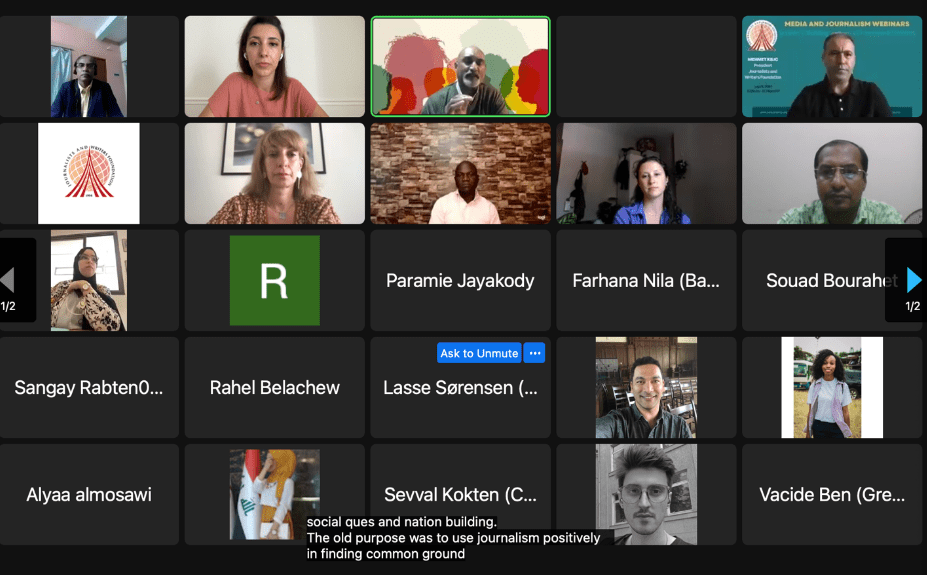
On July 27, 2022, the Journalists and Writers Foundation held the 2nd Session of the Media and Journalism Webinars 2022 on “The Role of Journalism in Creating Stable Societies”. This year’s webinars welcomed 33 participants from young journalists and journalism students from 18 different countries.

JWF Media and Journalism Webinars 2022 is a free virtual certificate program that emphasizes experiential and hands-on learning through intensive workshops, webinars, mentoring and interactive discussions with professional journalists for hands-on field experience. The program aims to provide participants with ideas to research, plan, execute and write news articles/stories that will raise awareness and public opinion on various issues of local, national and global concern.

Session 2: Role of Journalism in Creating Stable Societies address the following highlights: 

  1. Supporting vibrant civil society and fundamental rights
  2. Journalism for social good: role of media in strengthening social fabric and stability 
  3. Journalists being a part of the solution or the problem: roles and responsibilities 
  4. Journalists as public opinion builders and stewards of democracy and human rights 
  5. Rebuilding local news while empowering the needs of society
4421231

Media and Journalism Webinars are hosted by Yazeed Kamaldien, journalist from South Africa who has worked in print, radio, television and documentary filmmaking. Yazeed opened the session by introducing the speakers: Uday Basu, Chair, International Association of Religion Journalists from India; Dr. Rajendran Govender, Social Cohesion Advocate and Newspaper Columnist from South Africa; and Marika Djolai, Team Leader and Key Expert of ‘Global  Exchange on Religion in Society from Germany.

Yazeed Kamaldien: What are the roles and responsibilities of journalists in creating stable societies?

session-2-marika-djolaiMarika Djolai shared her views on this important issue underlining that journalists and media professionals have a transformative role in ensuring stability and reducing instability. Unfortunate events create or motivate some journalists to take a more independent side. According to Marika, the role of journalists is shaped by access to information and freedom of expression. Marika also informed the audience about the ‘Global Change on Religion in Society’ project by discussing the importance of freedom of religion in journalism and the different levels of engagement of religious actors with society. Marika also stressed the importance of religious journalists and recognized their effective reporting as they stabilize and initiate information transfer between journalists and civil society actors.

speakers_0006_yazeed-kamaldienBefore introducing Uday Basu, President of the International Association of Religious Journalists, Yazzed Kamaldien informed the participants about the association that was established to enable journalists to report on religion. Yazeed also highlighted the fact that there is a difference between being a religious journalist who follows a particular faith (i.e. Catholic Church Media) and being a religious journalist. Religion journalists write in a way that is not concerned with propagating religion, but by asking questions about religion and providing individuals with safe platforms for dialogue to learn more about the dynamics of religions. However, as he underlines, religious journalism is still journalism; they should be accountable within the framework of the same journalism ethics and principles, but should not make propaganda. Religious journalists with ethics and principles should contribute to creating stable societies, but not fuel conflicts.


Yazeed Kamaldien: How does the International Association of Religion Journalists ensure that journalists are a part of creating stable societies?

speakers_0000_uday-basuUday Basu stated that journalism is an integral part of democracy, that is, managing according to the priorities of the people. Journalism acts as an ally of democracy by providing an unending flow of information about public life in all spheres. Journalism comes into play when an attempt is made by any individual, group, community, political body, or government to destabilize public life, societal values and norms. According to Uday, it is the duty of an honest journalist to raise public awareness, to inform people about such initiatives, and to aim to protect democracy and sustain inclusive and diverse societies.


Yazeed Kamaldien: How does journalism play an important role in creating stability in societies?

Dr. Rajendran Govender shared his expert view on how a transformed media can play an important and meaningful role in enabling citizens to have greater access to information that can promote peace and harmony and ensure freedom of expression and the press. These constitutions also protect the right of access to information. Dr. Govender underlined that a transformative media can enable individuals to make informed choices rather than being misled by unconvincing information that is often difficult to moderate on social media platforms. Many social media platforms foster fear and injustice by heightening feelings of fear and anxiety.

At the end of the event, Marika once again underlined that journalism is not just telling the truth, but telling the wrong. Reliable journalism is essential in creating peace and ultimately stability. Dr. Govender added that while building sustainable societies, religious journalists should carefully evaluate their target audiences, taking into account social groups with different cultures and religions. Finally, Yazeed underlined the need for increasingly balanced reporting; analysing the same content from different perspectives is essential for media diversity and journalism to promote peace and stability.

RESOURCES:

Global Exchange on Religion in Society (GERIS) is a two-year project of networking, societal capacity building and social media engagement. The project aims to contribute to social inclusion and societal resilience by setting up a global community-based exchange initiative. Through this action, the European Union is setting up a network of civil society actors, whether secular or faith based, to connect their experiences of coexistence among people of different faiths, and none, in societies across the globe.  Through the creation of GERIS Network, the EU also wants to explore a specific model for engaging these actors working on a range of societal issues. The project objective will be achieved by building an exchange platform to contribute to the global conversation on diversity, coexistence, and social inclusion in society, on civic engagement and a more active, participatory, and shared sense of citizenship across boundaries of belief and worldviews.   

Link: https://europa.eu/capacity4dev/global-exchange-on-religion-in-society-geris- 


The Statesman – One of India`s most prominent media outlets 

The Statesman is an Indian English-language broadsheet daily newspaper founded in 1875 and published simultaneously in Kolkata, New Delhi, Siliguri and Bhubaneswar. It incorporates and is directly descended from The Friend of India, founded in 1818.

Link: https://www.thestatesman.com 


Department of Sport, Art and Culture of South Africa – Social Cohesion Advocates 

http://www.dac.gov.za/content/social-cohesion-advocates-0 


The Ethical Journalism Network

The Ethical Journalism Network aims to strengthen the craft of journalism and to promote for the public benefit high ethical standards in media through education, training and publication of useful research.

Link: https://ethicaljournalismnetwork.org 

BBC Editorial Guidelines

https://www.bbc.com/editorialguidelines/guidelines  


The International Association of Religion Journalists 

The International Association of Religion Journalists is a global network of journalists promoting excellence in the coverage of religion and spirituality. The IARJ works to build a respected professional body that can transcend national and regional biases. We offer a compelling perspective and are a trusted source of support and an indispensable resource for journalists worldwide reporting on religion.

Link: https://www.theiarj.org 

Building a career in Freelance Journalism

screen-shot-2022-06-07-at-9-05-46-pm
session-1

July 25, Monday (11:00 AM - 12:30 PM EST)

Media and Journalism Webinars emphasize experiential and hands-on learning through intensive training and interactive discussions with professional journalists for field experience. This program aims to prepare journalism students and young professionals to succeed in their professional careers while fostering experiential learning by translating knowledge and skills into experience.


In this session, participants will be able to learn about the following topic and subjects from professional journalists and media personalities. Your active and meaningful participation with questions and reflections will make the discussion more productive.  

Building a career in Freelance Journalism


  1. Making a living as a freelance journalist

  2. Building an audience

  3. Pitching stories, exposure to editors and publishers

  4. Challenges and opportunities for freelance journalists who do not want to work full-time for one media organization.

Guest Speakers

Yazeed Kamaldien

Journalist, South Africa

speakers_0006_yazeed-kamaldienYazeed Kamaldien is from Cape Town, South Africa, and is a journalist who has worked in print, radio, television and documentary filmmaking. He has reported from and lived in various countries, including conflict zones such as Yemen, Syria and the Gaza Strip. He is a founding member of the International Association of Religion Journalists (IARJ) aimed at promoting accuracy and fairness in religion reporting. Yazeed is currently also part of the Global Exchange on Religion in Society (Geris), a two-year project funded by the European Union, set up to facilitate a global conversation on diversity, coexistence and social inclusion. He is currently based in the United States.

Jordan Gass-Poore`

Podcast Producer, Investigative Journalist, USA

session-1-jordan-gass-pooreJordan Gass-Pooré is an award-winning podcast producer and investigative journalist with more than a decade of journalism experience. Presently, Ms. Gass-Pooré is the creator, producer, and host of “Hazard NJ,” a limited-series podcast about the impacts of climate change on hazardous Superfund sites in New Jersey. This podcast is in collaboration with the PBS affiliate NJ Spotlight News.
Prior to this, Jordan Gass-Pooré was a producer of CNN’s podcasts, “Chasing Life” and “Coronavirus: Fact vs Fiction,” both hosted by Dr. Sanjay. She is also a producer of the investigative podcast “Sounds Like Hate,” created by the Southern Poverty Law Center and Until 20 Productions. She has a master’s degree in investigative journalism from City, University of London and a bachelor’s degree in journalism from Texas State University.

Abdullah Bozkurt

Director, Nordic Monitor, Sweden

session-1-abdullah-bozkurtAbdullah Bozkurt is a journalist for over 20 years and is president of the Stockholm Center for Freedom (SCF), a monitoring group that tracks human rights violations in Turkey. He is also the director of the Nordic Research and Monitoring Network, which investigates terrorism, security, crime and extremism, and the author of Turkey Interrupted: Derailing Democracy. Mr. Bozkurt founded the Muhabir News Agency, which was shut down by the Turkish government in July 2016. He was also bureau chief for the Ankara-based daily Today’s Zaman, and served as its Washington, D.C. correspondent.

Summary & Highlights

On July 25, 2022, the Journalists and Writers Foundation held the first session of the Media and Journalism Webinars 2022 on building a career in freelance journalism. These virtual webinars are organized as a certificate program emphasizing experiential and hands-on learning through intensive workshops, webinars, training, field trips, mentoring and interactive discussions with professional journalists for hands-on field experience. During 5 sessions, each focusing on a different topic, participants from all over the world met with 10 expert speakers from the USA, Sweden, Germany, India, South Africa, Greece, Ukraine, and the United Kingdom.

Media and Journalism Webinars are hosted by journalist Yazeed Kamaldien from Cape Town, South Africa. Yazeed is a freelance journalist, who has worked in print, television, radio and documentary filmmaking, He has lived and reported from various countries including conflict zones such as Yemen and Syria. Yazeed is a founding member of International Association of Religion Journalists which aim at promoting accuracy and fairness in religion reporting. 

speakers_0006_yazeed-kamaldienYazeed Kamaldien started the session by introducing the speakers Jordan Gass-Poore, podcast producer and investigative journalist from the USA, and Abdullah Bozkurt, journalist and director of the Nordic Monitor based in Sweden. In explaining the main opportunities and challenges of freelance journalism, Jordan began with the basic question of freelance journalism, emphasizing the freedom to report and the nature of remote work, while highlighting that most journalists, as freelance journalists, are exempt from employer health insurance.

Media and Journalism Webinars are hosted by journalist Yazeed Kamaldien from Cape Town, South Africa. Yazeed is a freelance journalist, who has worked in print, television, radio and documentary filmmaking, He has lived and reported from various countries including conflict zones such as Yemen and Syria. Yazeed is a founding member of International Association of Religion Journalists which aim at promoting accuracy and fairness in religion reporting. 

session-1-jordan-gass-pooreJordan Gass-Poore strongly recommends that you try freelance journalism. Unlike Jordan, Abdullah said that health insurance is available in Sweden, so he wasn’t too worried on his part, agreeing with Jordan that there are many pros and cons when it comes to freelance journalism. He emphasized that being a full-time journalist allows him to focus more on his content, as you have different departments working for you and assisting journalists. Abdullah emphasized to the participants that for freelance journalism, you have to do everything yourself, you have to plan your own calendar, you are free. However, Abdullah also informed the participants about the disadvantages of freelance journalism in terms of legal cases such as lack of health insurance and liability insurance. He shared his own experience of facing various challenges in freelance journalism.

Yazeed Kamaldien: How can you become a freelance journalist?

Jordan shared that she started freelance journalism during her high school years, meeting people by participating in different events, and then communicating with them, following them and telling their stories. She started her career as a freelance journalist despite being widely rejected in the early days. Yazeed also emphasized that “networking” was vital in the early days of his journalism career.

session-1-abdullah-bozkurtAbdullah Bozkurt, who started his career as a freelance journalist during his graduate education, spent a lot of time in the Department of Journalism at Columbia University and shared his own experiences. He started to write freelance articles and write stories for newspapers in Turkey. Abdullah started his career as a freelance journalist by choice, and later joined an organization, attracting the attention of participants where he worked as a full-time journalist. He stressed that freelance journalism has many challenges at different levels, but if your heart is in this profession and as soon as you create good content and stretch yourself to different limits to find coverage, then you can find more. can develop the story from there.

In Session 1, all participants participated in a fruitful discussion by asking practical questions about freelance journalism.

Rana Ozakca: Is it worth going to Journalism Graduate School?

Rana Ozakca, a participant from the United Kingdom, asked a question about the value of going to the Journalism College. Abdullah answered this question by sharing one of his experiences of meeting young colleagues who jumped into graduate school after experiencing freelance journalism in the field. He shared that having some experience in journalism before being accepted into journalism graduate school gives you more learning, confidence, visibility and credibility. According to Abdullah, “credibility is the most valuable commodity any journalist can have.” Studying in journalism school is important for learning principles and values, but you can gain a great deal of experience as freelance journalism, practicing and working in the field.

Mercy Achieng: How can you stand out uniquely in public as a freelance journalist?

Mercy Achieng, a participant from Kenya, asked a question about uniquely standing out in public as a freelance journalist. Abdullah and Jordan addressed the question posed: Abdullah sasaid that “great content is the key to journalism” and with the article having a wealth of references, sources and evidence that helps and further assist in creating very specific content that help you stand out from the rest of the crowd. Jordan shared her experiences of her early career in publishing, and she did so by adopting a unique way of “co-authoring the text-based article by creating an audio version of those articles.” Yazeed, addressing the participants, underlined that they should first decide on their own area of ​​interest about what kind of journalist they want to be. It’s important to find your niche and find the topic you want to write about.

Rachel Nduati: How can you ensure objectivity and avoid bias as a freelance journalist? 

Rachel Nduati, a participant from Kenya, a broadcast journalist and digital entrepreneur asked questions about subjectivity while doing freelance Journalism where chances of being objective can happen. How can you ensure not to be biased as a freelance journalist and to ensure that audience can relate the story as it is but not based on the own biasing of a freelance journalist?

Abdullah Bozkurt said that there are a lot of checks and balances when working in full-time journalism or large media organizations, but mistakes can happen in freelance journalism when you are the only person looking at your article from different angles. Abdullah stated that the article can be shared as a raw material to get the opinions or judgments of your target audience or colleagues, so that you can make changes later by getting their views.

Our participants made Session 1 very interesting by asking different questions and actively participating in the discussions.

44211

Abu Naser Anik: What are the risks for freelance journalists when reporting corruption or criminal activity?

Abu Naser Anik, a participant from Bangladesh, asked about the risks of freelance journalism when a journalist is covering corruption or some criminal activity. He stressed that many journalists in his home country, Bangladesh, are afraid of freelancing. Abdullah answered this question regarding the political and security aspects of journalism while sharing his analysis of the pressures on media and press freedom in Turkey. Abdullah emphasized the importance of accepting the facts, taking precautions on a personal level, and approaching the authorities for security and safety. Sometimes security measures can break down and the person may be the victim of an attack. Journalism is a public interest business, and there are some metrics and factors that you should control by watching from different angles.

Yazeed Kamaldien also touched upon the question asked by our Bangladeshi participant. He mentioned some of the programs run by non-governmental organizations such as the “Committee to Protect Journalists” and others, which help journalists to broadcast news in temporary and life-threatening situations, which are not required to broadcast directly in their country, but which help journalists to broadcast news. To get the story to a prominent public and ensure that we are not silenced in a country where governments work hard to silence journalists who broadcast in such situations. Yazeed also stated that as a journalist, you should look into alternative sources where you can publish the work.

Both Jordan and Abdullah shared their insights into their career paths and shared their professional journeys with the audience. Abdullah stated that if a solid article can be worked on, it can stand out by maintaining its standards and lead society for positive social change.

session-1-jordan-gass-pooreJordan Gass-Poore emphasized that a journalist can only improve their work with continued professional development. Asked about the pressure on freelance journalists, Abdullah said that while working at a traditional media company, he was kept within certain limits and there was no room for error. However, freelance journalists manage their style and correct mistakes with no tension on audience and story-related issues. In addition, Jordan added that data-driven visualizations always require a high level of cross-checking to maintain transparency and credibility. According to her, collaborating with other colleagues is also a very productive reporting tool.

After answering a series of questions asked by participants on freelance journalism, Jordan informed the audience that many freelance journalists have applied for grant funding for long-term projects. Abdullah also advised the participants to attend some internship and training programs from well-established organizations with broad horizons, and they may be lucky by polishing their resumes and sending them to all media outlets. Addressing the youth, Abdullah said that if journalism does not sustain their lives financially, they need to take some steps to maintain the balance.

Session 1 ended by enlightening the brilliance of freelance journalism and closing remarks by our Host Yazeed Kamaldien and Speakers Abdullah Bozkurt, Jordan Gass-Poore.

RESOURCES:

Jordan Gass-Porre`s List of Freelance Point of Contact for future references and publish requests.  

US Outreach


NYC Radio: publicradionyc@googlegroups.com

GAYDIO: gaydio@googlegroups.com

LADIO (marginalized genders in audio): ladioNYC@googlegroups.com

Movement Journalism (Southern journalists): movementjournalism@presson.media

NC Audio Working Group (North Carolina): ncaudiowork@googlegroups.com

NJ Audio Group (New Jersey): njaudio@googlegroups.com

Philly Audio Community: philly-audio-community@googlegroups.com

Radio Chilanga: radiochilanga@googlegroups.com

TanyasTips: tanyastips@googlegroups.com

TwinCitiesRadio: twincitiesradio@googlegroups.com

Women in Sound: women-in-sound@googlegroups.com


International Outreach

Oz Audio (Australia): ozaudio@googlegroups

UKAN: ukaudionetwork@googlegroups.com


Thomson Reuters Foundation TrustLaw 

TrustLaw is the Thomson Reuters Foundation’s global pro bono legal service. It connects high-impact NGOs and social enterprises working to create social and environmental change with the best law firms and corporate legal teams, to provide them with free legal assistance. With a community of more than 6,500 members in over 190 countries, TrustLaw is the world’s largest global pro bono network.

Link: https://www.trust.org/trustlaw/ 


The Gumshoe Group

The Gumshoe Group supports freelance investigative reporters pursuing ambitious journalism in the public interest. Freelance investigative reporters produce brave, time-intensive work that news organizations often cannot undertake—at significant personal risk and with diminished structural and financial support. The Gumshoe Group supports freelance investigative reporters by connecting them with lawyers in the pursuit of public records, offering workshops and trainings, providing resources and tools, and coordinating investigative collaborations.

Link: https://www.gumshoegroup.org 


International Consortium of Investigative Journalists

The International Consortium of Investigative Journalists tells stories that punch through the noise, showing how the world really works, triggering positive change. It is driven by the belief that citizens have the right to be better informed, that access to independently sourced facts is not only essential for democracy but is also a fundamental human right. ICIJ is operating at a time when investigative journalism has never been more important, or more challenged. The biggest threats to our societies, and to all of us, have gone global, stretching the capacity of traditional newsrooms. Vital public interest reporting must compete against a flood of misinformation that confuses, alienates and divides. To fight these forces, ICIJ has directed the largest cross-border reporting initiatives in history, convincing reporters across the globe to set aside traditional rivalries to uncover corruption, abuses of power and grave harms inflicted on the world’s most vulnerable people. 

Link: https://www.icij.org 


International Women`s Media Foundation 

The IWMF works to unleash the power of women journalists to transform the global news media. Their fellows and grantees, both freelance and staff journalists, become experts in reporting in underserved regions, generate must-read stories, align with top outlets, and bring critical issues affecting women and others to light. IWMF is an organization that provides safety training, byline opportunities, and emergency support tailored to women journalists and photographers around the world. They also recognize fierce women journalists and photographers whose courage sets them apart and research the factors that allow journalism to remain dominated by men while advocating for inclusive practices that help propel women and minorities into leadership.

Link: https://www.iwmf.org 


Rory Peck Trust

The Rory Peck Trust provides practical and financial support to freelance journalists and their families worldwide, assisting in times of crisis and helping them to work more safely and professionally. We do this through assistance funds, our training fund, and online resources, as well as our annual Awards, which uniquely celebrate the work of freelance journalists. Based in London, the Trust works globally, with a network of international partners. It is co-founder of the Journalists in Distress (JID) network, a group of 22 like-minded organizations that provide support to journalists whose lives or careers are threatened because of their work. The JID network allows members to coordinate assistance and maximize their impact on a global level.

Link: https://rorypecktrust.org 


Coalition for Women in Journalism 

The Coalition for Women in Journalism fosters and supports camaraderie between women journalists around the globe. It is the first to pioneer a worldwide support network for women journalists. Through CFWIJ mentorship program and advocation for a safe and flourishing professional environment, they are creating spaces for women journalists where they can be nurtured, stay safe, and expand their skills. CFWIJ works with no national or ethnic boundaries and offer support to women from all backgrounds.


Link: https://www.womeninjournalism.org

Erosion of Financial Support for Journalism

Erosion of Financial Support for Journalism

    1.  How the internet changed the economics of the news business and damaged  newsgathering

    2. How consolidation of ownership and the rise of private equity have created “news deserts”

    3. The efforts underway by journalists and foundations to preserve and protect journalism

Week 1: Erosion of Financial Support for Journalism by Prof. Barbara Selvin, Stony Brook University

Learning Resources

Citizen Journalism

Citizen Journalism


  1. How can we ensure media ethics in citizen journalism and avoid myths, lies, and mistakes? 

  2. Comparative analysis between mainstream journalism and citizen journalism: Challenges and Opportunities

  3. Citizen journalism as a new tool for protests and giving a voice of the public

Week 2: Citizen Journalism by Yazeed Kamaldien, Freelance Journalist, South Africa

Learning Resources