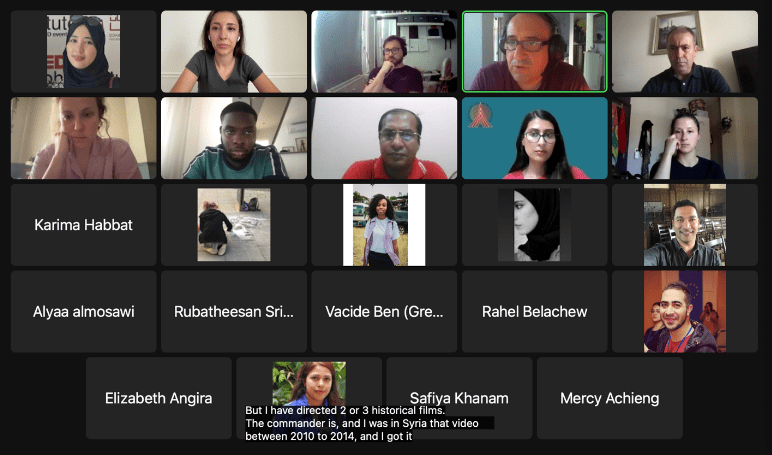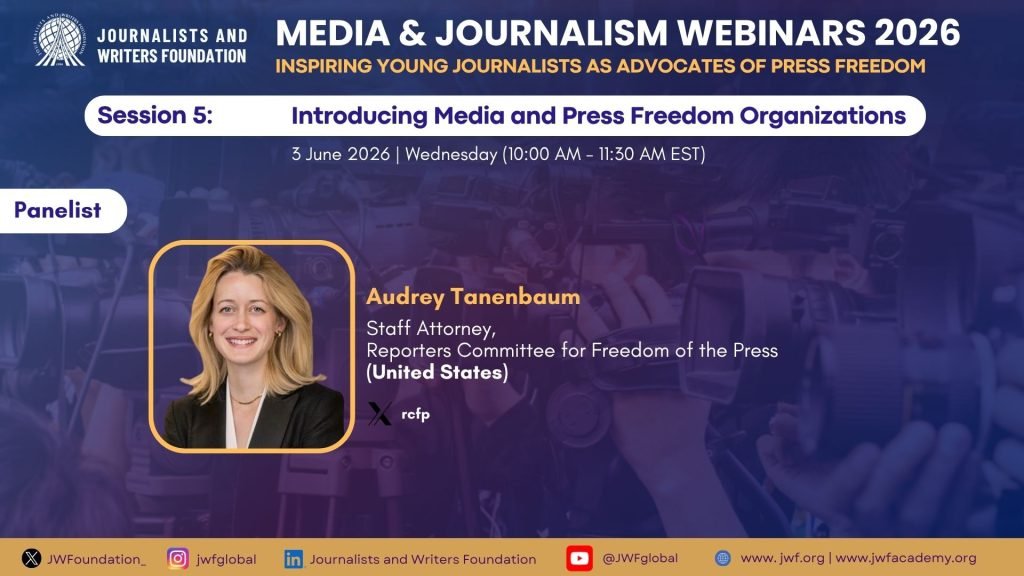
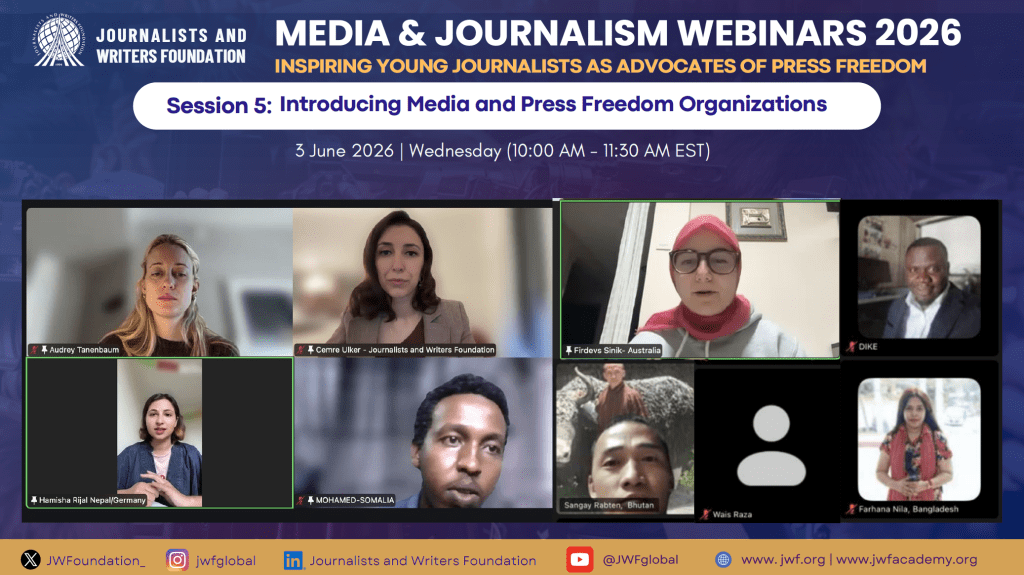
The Journalists and Writers Foundation hosted the fifth and final Session of the 7th Annual Media and Journalism Webinars 2026 on June 3, 2026, under the theme “Introducing Media and Press Freedom Organizations.” Held as part of the broader webinar series “Inspiring Young Journalists as Advocates of Press Freedom,” the session brought together young journalists, journalism students, emerging media professionals, and communications practitioners from different countries for an interactive discussion on press freedom, legal protections for journalists, access to information, and the role of media rights organizations in supporting independent journalism.
The final session served as a practical introduction to the resources, legal tools, and institutional support mechanisms available to journalists, particularly those working in environments where press freedom, civic space, or access to information may be restricted. The discussion highlighted the importance of knowing where journalists can seek guidance when facing legal threats, restrictions on access, protest-related risks, digital harassment, defamation claims, or barriers to public information.The session featured Audrey Tanenbaum, Staff Attorney at the Reporters Committee for Freedom of the Press, a United States-based nonprofit organization that provides legal support and advocacy for journalists and news organizations.
 Audrey Tanenbaum began by introducing the work of the Reporters Committee for Freedom of the Press, one of the oldest nonprofit organizations in the United States working to defend journalists’ First Amendment rights and support press freedom. She explained that the organization assists journalists and news organizations through several key areas of work, including a legal hotline, legal guides, litigation, amicus briefs, state-level legal support, and trainings for journalists. The Reporters Committee’s work is primarily focused on journalists reporting within the United States, but its model offered participants from different countries a valuable example of how press freedom organizations can provide practical and legal support to media professionals.
Tanenbaum noted that the organization’s legal hotline serves as a central entry point for journalists seeking guidance on newsgathering rights, access to public records, court documents, protest coverage, and other legal questions. She explained that in recent years, many hotline inquiries have involved journalists covering protests, where questions around access, safety, arrest risks, photography, and video recording have become increasingly important. This overview helped participants understand that press freedom is not only a broad democratic principle, but also a practical legal concern that affects journalists in their everyday reporting.
Tanenbaum also introduced the Reporters Committee’s legal guides, which provide journalists with accessible information on legal issues related to reporting in the United States. These guides cover areas such as immigration reporting, access to government records, court documents, illegally obtained information, recording laws, and the Freedom of Information Act. She explained that legal questions can arise in many reporting contexts. For example, journalists covering immigration enforcement may need to understand their rights near borders, in immigration courts, or when accessing related filings. Journalists may also receive information from sources that was obtained illegally, raising important questions about publication rights and legal safeguards.
Tanenbaum also discussed recording laws in the United States, noting that rules vary by state. Some states allow one-party consent, where only one person in a conversation needs to consent to recording, while others require all parties to agree. For journalists, understanding these differences is essential to responsible and lawful reporting. The session emphasized that legal literacy is a critical professional skill for journalists. Knowing the law can help journalists protect themselves, their sources, their reporting materials, and the communities they cover.
A key part of Tanenbaum’s presentation focused on the Local Legal Initiative, a program that recognizes the importance of state-level media law in the United States. While the First Amendment provides important protections for journalists, many practical legal questions are shaped by state law, including public records access, court access, and local legal procedures. Through the Local Legal Initiative, attorneys based in different states support journalists and news organizations with state-specific legal questions. This may include advising on public records laws, helping journalists access court documents, or advocating to unseal records.
Tanenbaum explained that access to public records and court documents is central to accountability journalism. When journalists face delays, denials, or barriers to information, legal tools can help them challenge those restrictions and uphold the public’s right to know.
The session highlighted that strong journalism depends not only on reporting skills, but also on the ability to access documents, verify information, and hold public institutions accountable through lawful and transparent processes.
 Litigation, Amicus Briefs, and First Amendment Advocacy
Tanenbaum also discussed the Reporters Committee’s litigation and advocacy work. The organization represents journalists and news organizations in cases involving freedom of information, access to court records, and other press freedom concerns.
In addition to direct representation, the Reporters Committee files amicus briefs in court cases where journalists’ rights and First Amendment interests are at stake. Even when the organization is not a party to a case, it can advocate for press freedom principles and help courts understand the broader implications of legal decisions for journalists and the public. During the discussion, participants explored how foreign journalists reporting in the United States can engage with legal resources and press freedom protections. Tanenbaum explained that many Reporters Committee resources may be relevant to foreign journalists physically based in the United States or covering U.S. topics.
She noted that foreign journalists reporting in the United States must follow applicable U.S. laws, such as state recording laws, but they may also benefit from legal protections available to journalists regardless of citizenship. For example, a journalist covering U.S. courts, public records, or public events may be able to rely on the same access principles available to U.S.-based journalists.
Tanenbaum emphasized that although the Reporters Committee does not provide legal assistance on foreign media laws, journalists can still reach out if they are unsure whether a question falls within U.S. law. The organization may also be able to direct journalists toward other relevant press freedom groups or resources. This discussion was particularly useful for participants who may study, work, or report internationally, reminding them that legal rights and responsibilities can change depending on where they are physically reporting and which jurisdiction applies.
Financial Pressure and the Future of Local News
Tanenbaum also reflected on the financial challenges facing journalism, particularly local journalism and freelance reporting. She noted that journalists and news organizations often face economic pressures at the same time they are confronting legal threats, political hostility, and changing media business models. Against this backdrop, she highlighted the growth of nonprofit news organizations in the United States. She described nonprofit news as an important and promising model for strengthening local journalism, especially as traditional advertising-based models continue to face challenges. This discussion connected legal protection with media sustainability. Press freedom requires more than legal rights alone; it also requires viable institutions, resources, and support systems that allow journalists to continue reporting in the public interest.
Digital Safety, Doxing, and Protection of Sources
The session also explored digital safety and online harassment. While Tanenbaum noted that her organization is primarily focused on legal rights rather than safety tracking, she acknowledged that online harassment, doxing, and technology-enabled threats are serious challenges for journalists.
She encouraged journalists to be careful about the personal information they make available online and to use secure communication tools when working with sources. She specifically highlighted the importance of protecting anonymous and confidential sources, noting that journalists must understand where information is stored, who can access it, and how communications can be kept secure.
This discussion reinforced a central lesson from the broader webinar series: journalist safety now includes legal, physical, digital, psychological, and reputational dimensions. For emerging media professionals, digital security is no longer optional; it is part of responsible reporting.
Who is a journalist?
A particularly important moment in the discussion focused on the definition of a journalist. Participants raised questions about press credentials, citizen journalism, and whether formal recognition by a state should determine who receives protection.
Tanenbaum emphasized that journalism should be understood broadly. A journalist is effectively someone who is conducting journalism. This includes freelancers, independent reporters, video journalists, citizen journalists, and people working outside traditional newsroom structures.
She warned against restrictive definitions of journalism, because governments can use narrow definitions to deny press credentials or exclude independent voices. She noted that strong journalism can come from people with nontraditional backgrounds, including those with expertise in coding, data, medicine, health, law, human rights, or other fields.
This point was especially relevant for participants working across disciplines. As journalism increasingly moves beyond traditional newsrooms, people from diverse professional backgrounds can contribute to public-interest reporting, data journalism, community storytelling, and human rights documentation.
As the 7th Annual Media and Journalism Webinars 2026 came to a close, JWF reaffirmed its commitment to supporting young journalists and emerging media professionals as advocates of press freedom. The program will continue as a year-long mentorship and empowerment platform, offering participants opportunities to strengthen their skills, expand their networks, and engage with global advocacy spaces.
The session concluded with a clear message: press freedom depends not only on courageous journalists, but also on strong institutions, legal protections, informed communities, and sustained solidarity. In an era of shrinking civic space and growing pressure on media professionals, young journalists must know their rights, protect their sources, build ethical reporting practices, and remain connected to organizations that defend the public’s right to information.
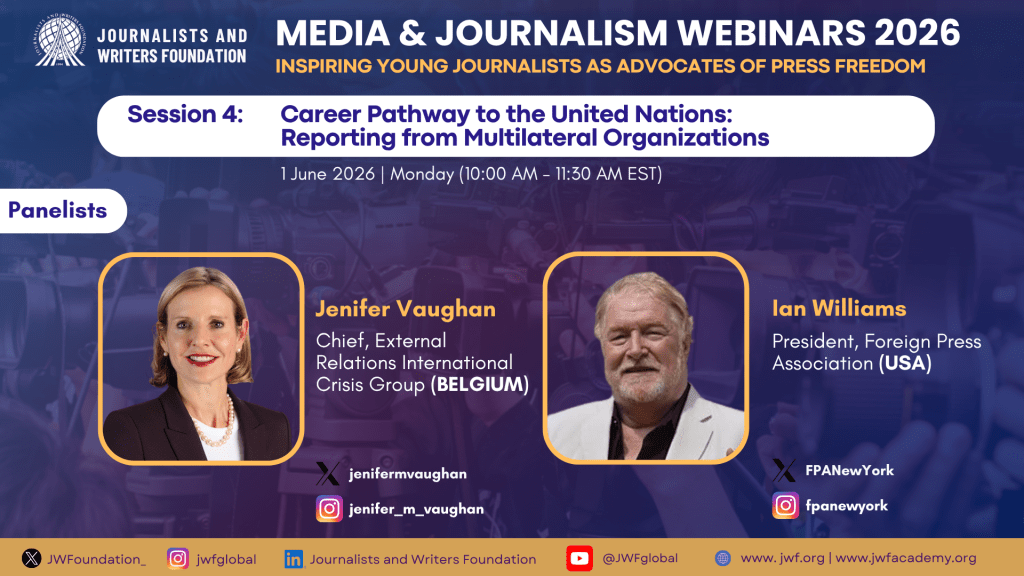
 The first speaker, Jenifer Vaughan, drew from her extensive career across journalism, diplomacy, academia, and multilateral communications. Her professional background includes senior roles at CNN and Al Jazeera, as well as United Nations work with the Office for the Coordination of Humanitarian Affairs, UNHCR, and the office of the UN Special Envoy for Syria. She also served as a Poynter Fellow in Residence at Yale University and recently joined the International Crisis Group as Chief of External Relations.
 The second speaker, Ian Williams, brought decades of experience as an author, journalist, broadcaster, and longtime observer of the United Nations. As President of the Foreign Press Association in the United States and a former President of the United Nations Correspondents Association, Williams has reported from more than 60 countries and has trained journalists in several regions.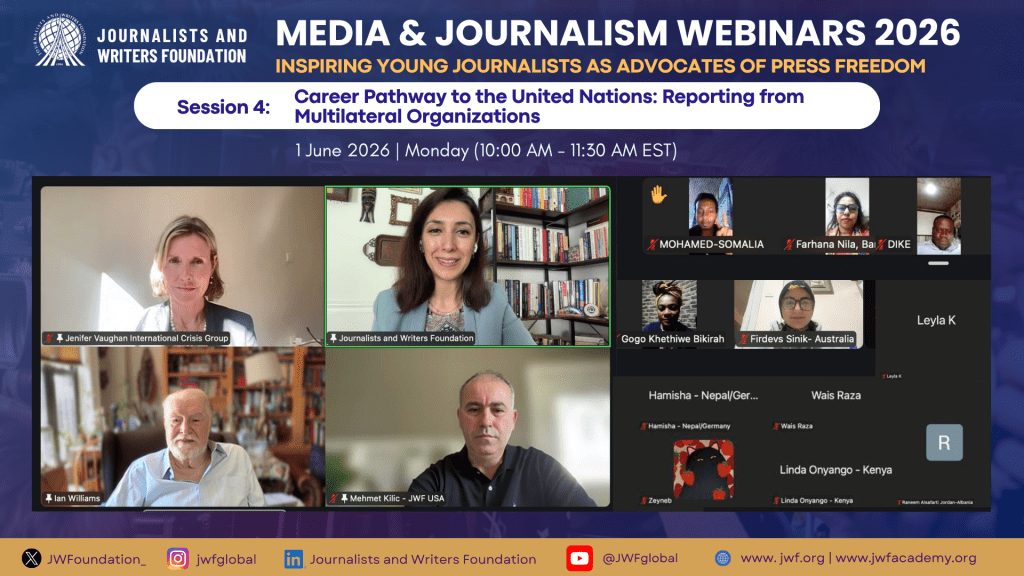
 The first speaker, JJ Green, opened his remarks by describing the migration of news and public discourse from traditional media institutions to virtual platforms as one of the most consequential transformations of our time. He emphasized that this shift is not only about technology, but also about trust, power, and democracy.
 According to Green, the shift from traditional media to virtual platforms has accelerated this problem. Traditional journalism, while imperfect, generally operated with editors, verification procedures, legal review, and professional standards. Virtual platforms have democratized publishing, allowing excluded voices to reach wider audiences and enabling communities to tell their own stories. However, decentralization also means fewer filters between information and the public.
 The second speaker, Dr. Belinha De Abreu, built on Green’s remarks by focusing on the importance of media and information literacy in the current information ecosystem. As a global media literacy educator, researcher, and author, she emphasized that media literacy has become increasingly central to democratic participation, civic life, and responsible engagement with digital platforms.
 This kind of critical inquiry is especially important for young journalists and emerging media professionals, who must navigate a world where the boundaries between journalism, entertainment, influence, activism, advertising, and opinion are increasingly blurred. Dr. De Abreu’s remarks reinforced that media literacy is not only about identifying false information. It is also about understanding the broader systems that shape visibility, credibility, trust, and public conversation.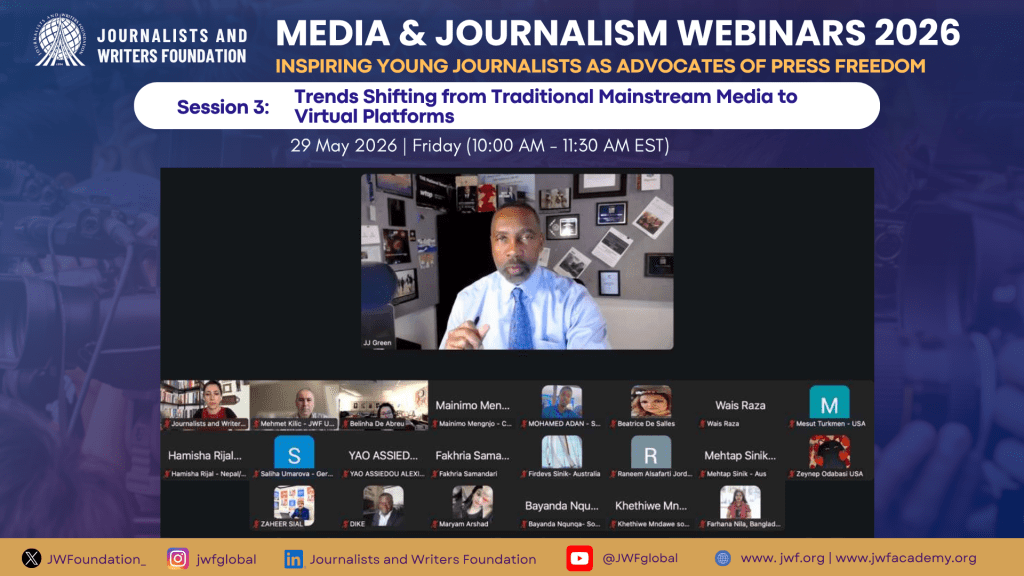
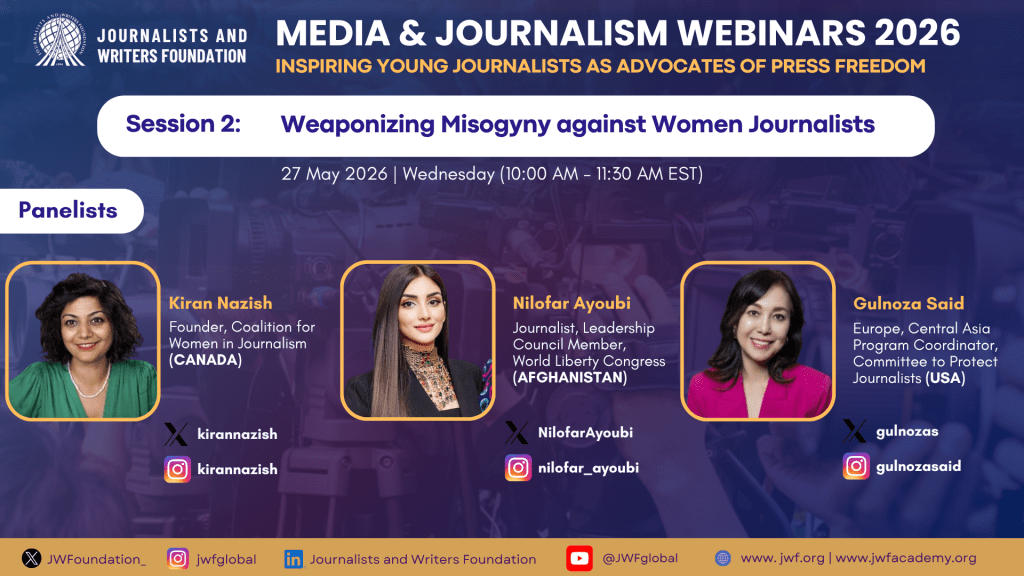
 The session featured three distinguished speakers: Kiran Nazish, Founder of the Coalition for Women in Journalism; Nilofar Ayoubi, Afghan journalist, and Leadership Council Member at the World Liberty Congress; and Gulnoza Said, Europe and Central Asia Program Coordinator at the Committee to Protect Journalists.
 The second speaker, Nilofar Ayoubi, offered a deeply personal and powerful reflection on the lived experience of misogynistic attacks, digital violence, and authoritarian targeting. As an Afghan women’s rights defender and journalist, she connected the session theme to her own life, beginning from childhood under Taliban rule, when she was disguised as a boy in order to access education.
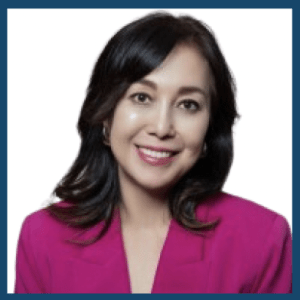 The third speaker, Gulnoza Said of the Committee to Protect Journalists, broadened the discussion by drawing from her work across Europe, Central Asia, and other regions. She emphasized that online harassment against women journalists is not limited to authoritarian states. It occurs in democratic countries as well. Said noted that during CPJ missions to different countries, women journalists repeatedly reported online harassment regardless of whether they worked in authoritarian or democratic environments. This shows that gendered attacks against women journalists are a global press freedom concern, not a problem confined to one region or political system.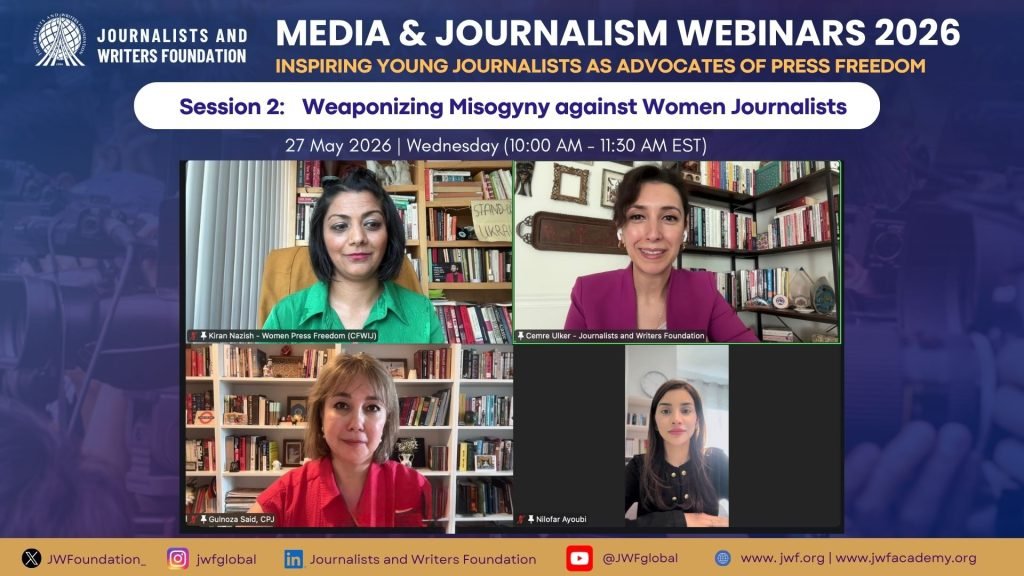

 Michael Bociurkiw began by acknowledging the increasingly difficult environment in which journalists operate. He noted that journalists in many countries face pressure from governments, corporate interests, conflict environments, disinformation, declining trust, and shrinking funding for independent media. Drawing from his experience in newsrooms, international reporting, humanitarian communications, and live broadcast analysis, Bociurkiw emphasized that credible journalism begins long before publication or broadcast. It begins with preparation, research, and verification.
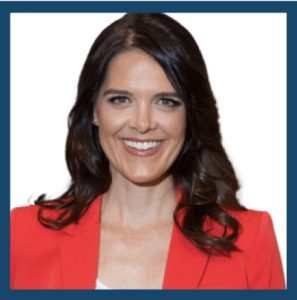 The second speaker, Laurie Watkins, deepened the discussion by focusing on credibility, trust, and long-term professional responsibility. Drawing on her experience across politics, policy, media, messaging, campaigns, public affairs, and commentary, Watkins reminded participants that in a noisy information ecosystem, credibility becomes a journalist’s currency. She explained that journalism is a long game. A journalist’s reputation is built over time through consistent accuracy, responsible judgment, ethical conduct, and the ability to earn trust from audiences, sources, editors, and institutions.
 Through the insights of Michael Bociurkiw and Laurie Watkins, participants were encouraged to approach journalism as a long-term commitment to credibility and public service. The session reminded young journalists that personal brand should never become more important than truth, and that the strongest media professionals are those who combine courage with discipline, independence with responsibility, and visibility with integrity.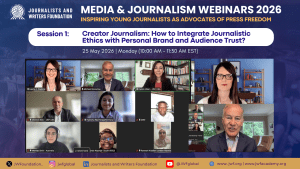

 Session 1: Creator Journalism: Integrating Ethics with Personal Brand and Audience Trust
 Session 2: Weaponizing Misogyny Against Women Journalists
 Session 3: Trends Shifting from Traditional Mainstream Media to Virtual Platforms
 Session 4: Career Pathway to the United Nations: Reporting from Multilateral Organizations
 Session 5: Introducing Media and Press Freedom Organizations

 Ian Williams is the President of the Foreign Press Association of the U.S. for over 20 years. He is a frequent contributor to the Guardian’s “Comment is Free” section and is regular columnist for George Orwell’s old newspaper, Tribune. He has also been a regular contributor to the Daily Telegraph, the Financial Times, the European, The Observer, and The Independent for which he was one of the founding writers. Mr. Williams was for years a columnist for the New Statesman.
  Stéphanie Fillion is a French-Canadian journalist specializing in foreign affairs and a United Nations Correspondent. She currently covers the UN for the Japanese newspaper Asahi Shimbun and is a contributor to Radio-Canada, Forbes, and Foreign Policy. She has worked for Radio-Canada in Vancouver and was a San Paolo fellow at La Stampa in Turin.
  Stephanie made a presentation on UN reporting and discussed various sources for UN reporting, which included spokespersons, diplomats, UN staff, retired diplomats/employees, NGO representatives, civilians, government officials, experts, media outlets and journalists (especially on the ground). Stephanie also discussed the challenges and possibilities associated with UN reporting.
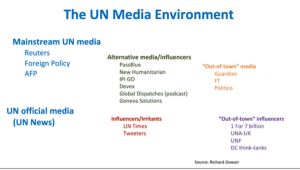 Stephanie stated that she needs to diversify her sources when it comes to politics and story search. He stressed that addressing the war crisis in Russia and Ukraine is one of his most difficult tasks, which he called a challenge for journalists working at the UN. Yazeed also stressed that being politically correct is not always the primary purpose of entities, but rather getting the facts right.
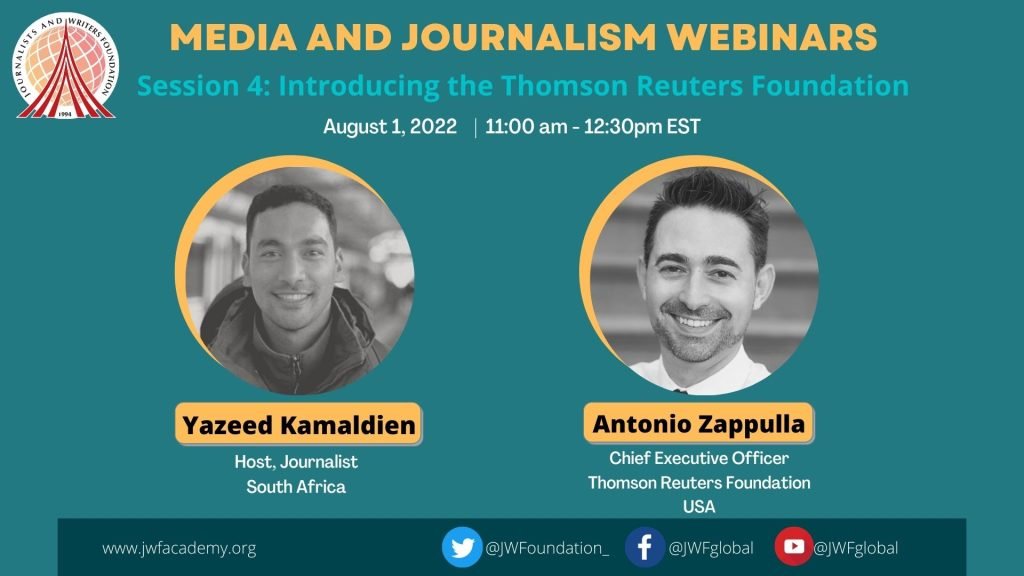
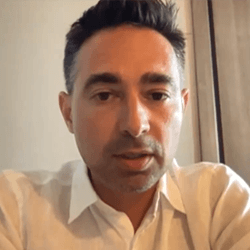 Antonio Zappulla OMRI is Chief Executive Officer of the Thomson Reuters Foundation, the charitable arm of Thomson Reuters, the world’s leading content-driven technology company. Through news, media development, free legal assistance and convening initiatives, the Thomson Reuters Foundation harnesses the combined power of journalism and the law to advance media freedom, raise awareness of human rights issues, and foster more inclusive economies.
 Antonio Zappulla believes that societies should be free, fair and informed by focusing on socioeconomic inclusion, reinforcing ESG frameworks, and ensuring access to accurate dependent and reliable data through news, fair work and gathering initiatives. The goal of the Thomson Reuters Foundation is to shape a rich planet with everyone, without leaving anyone behind. Antonio underlined that his organization is based entirely on doing great things through media use and legal interventions. According to Mr. Zappulla, the media and law are effectively the two engines of work needed to liberate societies of all kinds. Antonio stated that a free, just, and uninformed society cannot function and be beneficial. He also highlighted that the Foundation was launched in 1982 and has one hundred and fifty employees in more than 17 countries around the world.
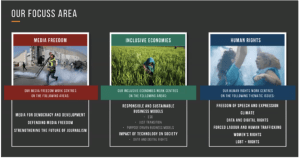 The Thomson and Reuters Foundations have 3 main areas of focus: the first is “Media Freedom” – having the media work center for democracy and development, defending media freedom, empowering the future of journalism, and also focusing on acquiring an educational portfolio, especially for journalists in developing countries in the global south mentoring and capacity building programs. The second main focus area is the work center of responsible and sustainable business models, ESG, just transition, purposeful business models, technology impact on society, realities and digital rights, and “inclusive economies”. The third area of focus is human rights, working on thematic issues such as freedom of speech and expression, climate, facts and digital rights, forced labor and human trafficking, women’s rights and LGBT+ Rights.
 Antonio also informed the participants that Thomson Reuters Foundation has a network of more than 20,000 journalists and 5,500 members working in 11 languages. It also talks about the launch of its new editorial product “CONTEXT” on September 28, 2022. He talked about the Foundation’s extensive program that annually gives grants to NGOs and journalists. Also, the Thomson Reuters foundation’s flagship “Confidence Conference” – Empowering free, fair and informed societies, this year draws the attention of the audience by announcing that this event will be held October 26-27, 2022, in London.
 Moving towards concluding the presentation, Antonio spoke about the launch of a new product known as TRFilter, which works heavily with twitter and uses its twitter account to detect abusive content


 Thomas Sideris is an investigative journalist and an award-winning director based in Greece. He is working at the Greek Broadcasting Corporation. Mr. Sideris was shortlisted for 2 years in a row (2018 and 2019) for the PRIX EUROPA PRIZE, a special EU prize for the best journalist in Europe.
 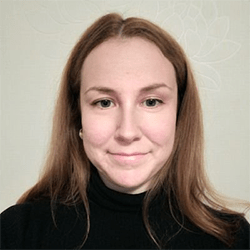 Isobel Koshiw is the Guardian Correspondent reporting from Ukraine. She has previously worked on investigations into transnational crime and corruption at NGOs and for international publications. Her investigations have appeared in OCCRP, The Verge, The New York Times, The Financial Times and The Times and Kyiv Post.
 Yazeed Kamaldien